Showing posts with label Carrion Crow. Show all posts

Sunday, 29 September 2019

Falcon Over the Fields

Our monthly bird survey on 27 September was almost over, when Conrad spotted a Hobby being chased by Crows over the north field. We had only a brief glimpse at first, but it reappeared having shaken off its pursuers and spent five minutes gliding and swooping over the park. The Hobby has long wings for its body size and catches most of its prey in flight, so its aerial abilities are quite special. It feeds mainly on small birds (though it does catch Swifts) and insects including dragonflies. In this case it was feeding around the plane trees that line Hilly Fields Crescent and we saw it transfer an insect from claw to beak in mid-flight. The plumage was not as dark as usual, so our bird may have been a juvenile. It was either too high or too fast to get a photograph - the image below is from the NatureSpot website.

Photo: Chris Lythall
The Hobby is one of four wild falcons which can be seen in Britain. The other three - Peregrine, Kestrel and Merlin - are resident all year round, whereas the Hobby is a spring migrant which flies here from Africa to breed in our cooler climate and returns in autumn. The hobby we saw will be away any day now. Its scientific name is Falco subbuteo and yes - the fingertip football game Subbuteo is named after it. Its inventor Peter Adolph was a bird lover and first tried to patent the game under the name of 'The Hobby'. When that was turned down as being too general, he used the species name instead which in Latin means 'near to' (sub) 'a buzzard' (buteo).


We recorded twenty other species that day which is a good record for the time of year. These were 14 Woodpigeons, 11 Feral Pigeons and 11 Magpies, 5 Robins (at least), 4 Great Tits, 3 each of Blackbirds, Blue Tits, Crows, Goldfinches, Jays and Wrens, 2 each of Black-headed Gulls, House Martins (passing over) and Song Thrushes, 1 each of  Chiffchaff, Herring Gull, House Sparrow, Nuthatch, Ring-necked Parakeet and Starling. The Hobby can be celebrated as the 51st species on our list, but let me also put in a word for the Crows. They tend to get taken for granted but are vigilant birds and defenders of the realm and they do draw attention to birds of prey.

Carrion Crow on Hilly Fields, 27-9-19


Thursday, 5 November 2015

Did I Mention the Crows?

We seemed to be followed by Crows when we did our monthly bird survey on 30 October. Noisy Crows, mean and hungry looking Crows. Perhaps they were warming up for Halloween next day. And the weather was sombre too, even after the rain stopped which meant many of the birds kept quiet and out of view. We saw most of the regulars, though not in great numbers and heard the occasional burst of Wren song around the wood and Upper Eastern Road. The Crows were there too, waiting for us in the autumnal trees.


We were expecting to see a few gulls on the cricket pitch when we reached the north field. They have been moving into Inner London for the winter. In the event, there was one solitary Black-headed Gull on the ground and maybe three or four up in the sky. That name - and I say this every year - is misleading. In spring and summer, its head is a beautiful chocolate brown colour; in winter, its head is white albeit with a small dark patch behind the eye. Note the red legs and bill.


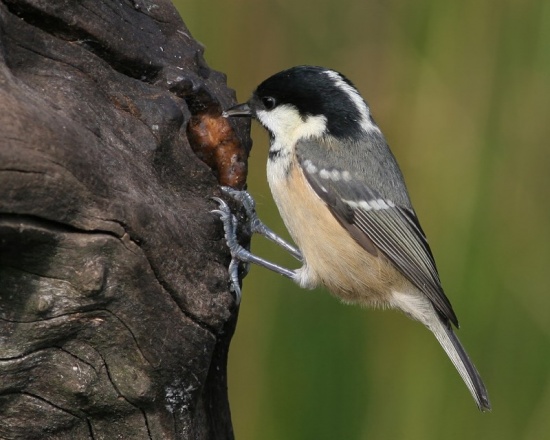
The best bird of the day - our reward for two hours of trudging - was waiting for us in the Cliffview hedge: a Coal Tit, seen briefly but clearly before flying away. The Coal Tit has a black head, hence its name, and is the same size as a Blue Tit. It has a prominent white patch at the back of the head. We've seen them before on Hilly Fields but not often. By the way, there were some Crows nearby too.

Photo by Ian F, BirdForum 
Actually, Crows are good to have around on the whole. They band together and mob birds of prey, driving them away, thus providing a service for the small bird community. And maybe saving a few pigeons too. Also, if you look closely, you'll see that their plumage isn't pure black but has some very subtle tinges of blue.


The full list of birds seen and/or heard comprises Wood Pigeons, Feral Pigeons, House Sparrows, Ring-necked Parakeets, Blackbirds, Robins, Wrens, Great Tits, Blue Tits, Goldfinches, a Coal Tit, a Black-headed Gull, Magpies and, er, Crows. A total of 14 species in all. And so after finishing our circuit, we trudged up the hill to the cafe. You'll never guess which bird turned up there.


Tuesday, 6 October 2015

The Quiet Quarter

Our arrival at the lower Vicars Hill Gate on 30 September was greeted by a faint seep-seep-seep sound from the trees which turned out to be a group of about six Long-tailed Tits scavenging for food. Other than that, our monthly bird survey was another low-key affair and confirmed that July-Sept is the 'quiet quarter' of the birding year on Hilly Fields.

Long-tailed Tit
The bird glimpsed most clearly in flight was a Jay which, as per last month, flew from the direction of the Brockley and Ladywell Cemeteries to nab another acorn from the oak tree at the top of the south field. Luckily, this tree has enough acorns left on its branches to feed many more squirrels and birds.

Acorns on oak tree
A Wren was briefly heard singing and a Chiffchaff. The latter was probably preparing for its annual migration back to the Med or West Africa. Apart from the bold Crows and Magpies which strutted in the open spaces, most of the other birds maintained a low profile like the blackbird below, glimpsed in hawthorn foliage on Upper Eastern Road.

Blackbird playing peep-o
Hopefully, by the end of next month, the Gulls and Starlings will have returned from wherever they spend their summer to swell the numbers. Species seen or heard this month: 7 Robins, 7 Woodpigeons, 6 Long-tailed Tits, 5 Magpies, 3 Crows, 2 each of Blackbird, Great Tit, Blue Tit and Ring-necked Parakeets, 1  each of Wren, House Sparrow, Chiffchaff, Goldfinch, Jay and Feral Pigeon.

After a skirmish which ruffled its feathers, this Crow was King of the Bin


Wednesday, 6 August 2014

Return of a Predator

Due to various commitments and crises, Sue and I ended up doing the July bird survey at 4.15 pm on 31 July. Afternoons are not normally the best time for bird watching and we had low expectations about what we'd find. And when we began our circuit around the park, our fears seemed to be borne out. The Vicars Hill and Veda Road borders were virtually silent. We spotted a Magpie and heard the faint churr of a Blue Tit from somewhere, but things were not looking or sounding good. In the little wood, we saw a Robin and heard a Parakeet. On the upper part of Eastern Road, we heard a Greenfinch and saw a small flock of about 5 Goldfinches.


Then, from the brow of the hill between Eastern Road and the school, Sue spotted a predator flapping away eastward, a dark shape difficult to identify in the few seconds that it was visible. A Sparrowhawk? Maybe. We carried on, feeling a little frustrated...but not for long. As we approached the slope above the wildflower meadow, Sue spotted the bird landing on one of the lime trees that border Adelaide Avenue. Soon after, it began an aerial tour of the south slopes and our predator became identifiable. A Kestrel! A female, in fact, and the first one that we'd seen at Hilly Fields since February 2012.


For the next forty minutes, we watched as it circled around, sometimes hovering with rapid wingbeats in that distinctive way Kestrels have, at other times gliding with wings outstretched. At one point, it perched on a tree for a short while and I was able to get some decent pics through the zoom lens. The focus of its attention was the long grass in the south meadow where it would have been looking for field mice and voles. Several times, it swooped down into the grass, but didn't appear to catch anything other than maybe a few invertebrates. A Crow and a Magpie arrived to hassle it at different times, but it simply flew higher and carried on. After about forty minutes, it disappeared over the school heading eastward again. As far as I know, it hasn't returned.


The Kestrel population across the UK has been declining in recent years, though there is some evidence that the decline is recovering a little. It was great therefore to see it at our park again and shows that meadow areas have value for other species as well as invertebrates and wild flowers. To distinguish between male and female Kestrels, you need binoculars or very good eyesight. The male has a grey head and markings like little black diamonds on its brown back. The female has a brown head and black barring across its back. Seen together, the female is a little larger and a slightly darker brown. Both have streaked breasts and their wings taper to a point.


After that, it was back to the common or garden birds. 8 Feral Pigeons, 6 Woodpigeons, 3 House Sparrows, a Blackbird, a Great Tit and a Swift added to the other birds seen made a total of 14 species which is low but comparable with previous years. The breeding season is more or less over now and many birds are resting or moulting. The Swift would have been gearing up for its return flight to Africa and most of its fellows seem to have gone back.

"Now where's that Kestrel gone? You look that way and I'll look this..."
Finally, I'm reminded that our original bird champion Keith saw a Kestrel (female, again) six years ago which did catch some prey in the meadow (as recorded here) and which conveniently posed for the camera though without looking too pleased!


Thursday, 3 April 2014

Return of the Chiffchaff

Our monthly bird survey on 26 March began well with the sighting of a pair of Jays in the trees along the Veda Road border. It is sometimes hard to believe that these birds with their colourful pink and fawn bodies and bright blue wing patches belong to the same family as the all-black Carrion Crow, but they do - as also do Magpies. Further on we saw a Crow with nesting material in its beak and as we worked our way round the park with Robins, Wrens, Great Tits and Blue Tits singing and calling, it was evident that the birds were busy preparing for the mating season.

Crow with nesting material in the children's playground
In the wood, we heard what I'd been hoping for - the song of a Chiffchaff. This is a small warbler with a pale lemony breast and a white stripe above the eye. It migrates to Britain every spring from the Mediterranean and West Africa. This year it got here just before the Saharan dust! It's only in the last 3 years that we've seen or heard Chiffchaffs on Hilly Fields and only last year that they stayed the whole summer and bred. A few days after the survey, I heard two Chiffchaffs singing and there may be a third somewhere in the trees around the Veda Road/Eastern Road back gardens. Their song is very distinctive and easy to remember. Here's a clip I posted on the blog last year


In the trees at the back of the tennis courts, we had some good views of a Great Spotted Woodpecker and later Judith saw a Mistle Thrush on the grass in front of the courts. There was no sign of any gulls - the mild weather has presumably tempted them back to the coasts. Next to the bothy, some sort of territorial skirmish was going on between a plucky little House Sparrow and two Blackbirds. Here's one of the latter peeping out rather cautiously from a bush:


In total, we saw and/or heard 19 different species. As well as those already mentioned, these include no less than 25 Feral Pigeons on the cricket pitch observed by Sue on her way home, 11 Starlings, 4 Woodpigeons, 2 Magpies, Goldfinches and Ring-necked Parakeets, a singing Dunnock and a solitary Long-tailed Tit. All in your local green space on a fine spring morning. I'll update on the Dawn Chorus Walk in a few days...


Friday, 6 July 2012

June Bird Survey

Friday 29th June: a cloudy morning with spots of rain, occasional glimmers of sun and a strong wind. The wind made it difficult to hear the birds and perhaps they weren't bothering to sing much anyway. It was also hard to see the small birds as all the trees are in full leaf. In short, we saw and/or heard only 13 species during a two hour survey and that's the lowest number recorded this year, down from 23 species in Jan, 22 in Feb, 16 in March and April and 14 in May. Crap weather may have something to do with it (wettest April-June quarter since 1910 etc.), but also the moulting season is beginning which means some birds will be keeping a low profile as they shed their feathers. 


The highest number by far was a flock of 20+ Woodpigeons foraging on the East field. After that, 4 Carrion Crow, 4 Blackbirds, 4 House Sparrows, 3 Starlings, 3 Feral Pigeons, 2 Magpies, 2 Goldfinches, 2 Wrens and 1 each of Pied Wagtail, Robin, Great Tit and Chaffinch. The Pied Wagtail was hopping about the bowling green only a few feet away from two Glendale workers who were mowing the grass, though it eventually flew away. From previous observations, the green is becoming a regular haunt for this attractive bird which feeds mainly on insects including flies, midges and caterpillars.

Stock photo - not the bowling green!
No sign of the Great Spotted Woodpeckers (see recent posts), but we did see a fledgling Carrion Crow following its mum or dad around near the cricket pitch, sometimes opening its mouth in hope of food. It's plumage at this stage is mainly dark brown rather than the familiar all-black of the adult. A few of the smaller birds we saw did look rather disheveled (though not this Crow) which may be due to the strains of producing and feeding their needy broods.


In the cherry tree just to the south of the newly opened cafe, we saw four blackbirds flitting around and pecking at the cherries. Easy to see the speckled breast of the female in the pic. below even if the camera is slightly out of focus. 


After that, we treated ourselves to a much-needed coffee!