Robins were singing here, there, just about everywhere when Sue and I did the monthly bird survey on 16 December. In fact, Robins sing most of the year except for a few weeks in July/August when they skulk in the undergrowth and moult. But in December, the frequency seems to be increasing. Do they know it's Christmastime? Well, of course they don't, despite having their likeness featured on Christmas cards for the last 150 years or more. But they do seem to sense that the year has reached a turning point and that the mating season is not far off. We watched a pair chasing each other around the upper part of Eastern Road and it was hard to tell whether it was territorial defence or early courtship.
A Song Thrush was singing in the little wood as well, repeating each phrase three or four times. This bird returned to Hilly Fields last year after a long absence but we haven't seen or heard it since last April. It's good to know that it's still around. Another welcome returnee is the Great Spotted Woodpecker which we saw for the first time in six months in the little wood and then later on upper Eastern Road. You can't tell from the angle of my photo (below) but the bird we saw is a female. The male has a red cap, the female doesn't. Both have red 'backsides'.
Although numbers are still not high, we saw a much greater range of birds than in recent months - 22 species in all. It was nice to see both a male and female Chaffinch - a bird we haven't come across since summer. And another Goldcrest in the garden next to the bowling green. We seem to be getting better at spotting these tiny birds, though there has been a winter influx of migrants to boost numbers. A Collared Dove was also in the garden - not that common in the park, although I hear one often on the other side of Vicars Hill. If you hear a pigeon cooing three times ('U-ni-ted!), it's a Collared Dove. If you hear a pigeon cooing five times ('How are you to-day?'), it's a Woodpigeon.
Finally, in the mild weather we sat outside at the cafe and had a good view of two Mistle Thrushes in the trees opposite. This is another bird with a Christmas connection in that it gets its name from its fondness for mistletoe berries. I don't think we have any mistletoe on Hilly Fields, but luckily the Mistle Thrush will eat all sorts of other berries (including the red hawthorn berries) and is fond of invertebrates too. In fact, you're most likely to see it on Hilly Fields picking about in the grass for worms.
Merry Christmas to all and don't forget that our Big Birdwatch event (in conjunction with the RSPB) will be held on Sunday 31 January from 10.30-12.30. More details in the New Year.
News of the Bird Champion Project of Hilly Fields, Brockley and Ladywell, SE London.
Showing posts with label Robin. Show all posts
Tuesday, 22 December 2015
Thursday, 6 November 2014
A Rainy Day In Autumn
| Juvenile male Blackbird, bill just starting to turn yellow |
| Robin singing against a grey, grey sky |
| First sighting this year of a lesser Black-backed Gull, seen twice in 2013 |
| Photo from http://www.birds.deansfamily.com/ |
Thursday, 2 October 2014
September Highlights
We had mixed weather on 24th September for our monthly bird survey, starting with a clouded sky which led to rain, then clearing to blue sky and sunshine. The birds were reasonably active for the time of year and there were three particular highlights. Firstly, clear views of a pair of Chiffchaffs in the hedging along the eastern boundary of the school site. One bird .in particular hovered with fluttering wings in front of the trees and bushes as it looked for food. The Chiffchaff's main diet consists of insects including plant aphids, but it will sometimes eat berries of which there was a supply in the hedge. At this time of year, they will be building up fat and energy reserves for the migratory flight back to the Med and West Africa. Difficult to photograph because of their quick movements but the pic below shows the pale, lemony breast, white stripe above the eye and black line through the eye. The Chiffchaff is about the same size as a Blue Tit.
The next highlight came when Sue spotted a Jay flying over the south field from the direction of the Brockley & Ladywell cemeteries. It landed in an oak tree, but after only a few seconds flew back the way it had come. We walked closer to the tree and soon discovered why its visit had been so short. There were already two Jays sitting in the branches and Hilly Fields is their territory. No way were they going to share their acorn supply. The Jay is the most colourful member of the Corvid family with its pink breast and the bright blue wing patches which often give away its presence when deep in foliage. Its call is a wild raucous screech.
The third highlight was the arrival of a small flock of Long-tailed Tits in the garden next to the bowling green. We became aware of them suddenly in the branches above us, twittering quietly to each other as they hopped around. Long-tailed Tits are very pretty birds but flit about so quickly that they're difficult to catch on camera. My photo taken from directly below shows the pale fluffy underbelly and the long tail which almost merges with the tree branches. I've added a photo from the Web which gives a clearer view of the whole bird.
Elsewhere, Blue Tits and Great Tits were active in the trees and we even heard the latter's two-note 'teacher, teacher' call briefly. Robins were singing again now that their moulting period is over and we estimate there are at least 11 of them holding territories in the park. The fact that Robins are so territorial and don't move around much makes it easier to do an accurate count. There were 18 Wood Pigeons feeding on the grassland, 8 Feral Pigeons wandering on grass and pathways and at least 8 House Sparrows in the Cliffview hedge. The rest of the count: 5 Swallows passing overhead, 3 each of Blackbird, Crow and Magpie, 2 Ring-necked Parakeets and one apiece of Goldfinch and Wren. Giving us the same total as last month: 16 species.
| Jay in Hilly Fields Wood |
![]() |
| Photo by Joe Cockram |
Thursday, 8 May 2014
Birdsong and Blossom
The first thing that greeted me after toiling up Vicars Hill on the last day of April was the sight and sound of a Robin singing from the top of an ash tree. It seemed to be revelling in the sunshine that had reddened its breast even more. Arriving from a different direction, Judith had already had a clear view of a Great Spotted Woodpecker so our monthly survey was off to a good start. Great Tits were calling repeatedly from the green borders of the park and Blackbirds, Chiffchaffs and Wrens were regularly bursting into song. Only the Blue Tits were quiet, presumably busy with their broods.
Along the Veda Rd border, we heard our first Blackcap of the year and at least one other was singing elsewhere in the park. This was a welcome return for these spring migrant warblers whose presence and song all adds to the diversity of the park. A pair overwintered in the area during 2012/13 but not this last winter as far as I'm aware. Greenfinches, a Goldfinch and a Dunnock were all heard singing in various locations, while a Blackbird seemed to be duetting with a Robin in the little garden next to the bowling green. But as the foliage grows denser, it's getting harder to see small birds and often the only glimpse we got was as they flew away. Here's a You Tube clip of a male Blackcap; the female has a chestnut brown cap.
In addition to those mentioned above, we saw or heard nine Starlings feeding on the grassland, five Wrens, four Crows, three each of Magpie, Woodpigeon and Ring-necked Parakeet and one each of Chaffinch and House Sparrow. We also heard a Magpie chick calling plaintively from its nest in a tree on upper Eastern Rd. Counting small birds in a large park such as Hilly Fields is always difficult, but we estimate there are at least nine robins spread around in different territories and probably more than the five Wrens that we've entered on BirdTrack.
Meanwhile in other nature news, the May blossom is out on the hawthorns as anybody who's been in the park recently can't help but have noticed. The creamy white 'candles' are on the horse chestnuts and of course the cow parsley is everywhere. In short, it's that time of year when 'everything is beeoodiful' as Ray Stevens warbled back in the 1960s. And the ash trees are finally blossoming too, their green pinnate leaves appearing alongside last year's seedcases (known as 'keys') which have somehow survived the winter gales.
Along the Veda Rd border, we heard our first Blackcap of the year and at least one other was singing elsewhere in the park. This was a welcome return for these spring migrant warblers whose presence and song all adds to the diversity of the park. A pair overwintered in the area during 2012/13 but not this last winter as far as I'm aware. Greenfinches, a Goldfinch and a Dunnock were all heard singing in various locations, while a Blackbird seemed to be duetting with a Robin in the little garden next to the bowling green. But as the foliage grows denser, it's getting harder to see small birds and often the only glimpse we got was as they flew away. Here's a You Tube clip of a male Blackcap; the female has a chestnut brown cap.
![]() |
| Woodpigeons canoodling in the sun |
| May blossom on the hawthorns |
| 'Candles' of blossom on the horse chestnuts |
| Old Ash keys and new leaves |
Tuesday, 3 September 2013
Last Days of Summer
August 28th was a fine sunny day for our monthly survey but the birds weren't coming out to play. We heard more than we saw and our final tally was only boosted to 13 species by the screeching of an unseen Jay and the brief glimpse of a Green Woodpecker which was probably visiting from Brockley & Ladywell cemeteries. Great Tits and Blue Tits were fairly active in the trees and small flocks of Crows, Magpies and Woodpigeons followed us about the park. The good news is that Robins are singing again after their summer moult when they retreat into the undergrowth and sulk. We estimated that we'd seen or heard 7 in total on our rounds.
We saw only one Blackbird which is unusual and heard the occasional Goldfinch. Three House Sparrows, two Ring-necked Parakeets and a Feral Pigeon made up the total. The week before, Sue had seen even fewer birds but had at least the excitement of watching a Sparrowhawk being chased by a Crow! Before going for a coffee at the cafe, we took a look at a recently vacated Robin's nest just inside the bothy gates which Lee the park keeper had pointed out to us - a cup nest created in thick ivy against a wall. I wonder how many chicks were born here and how many survived?
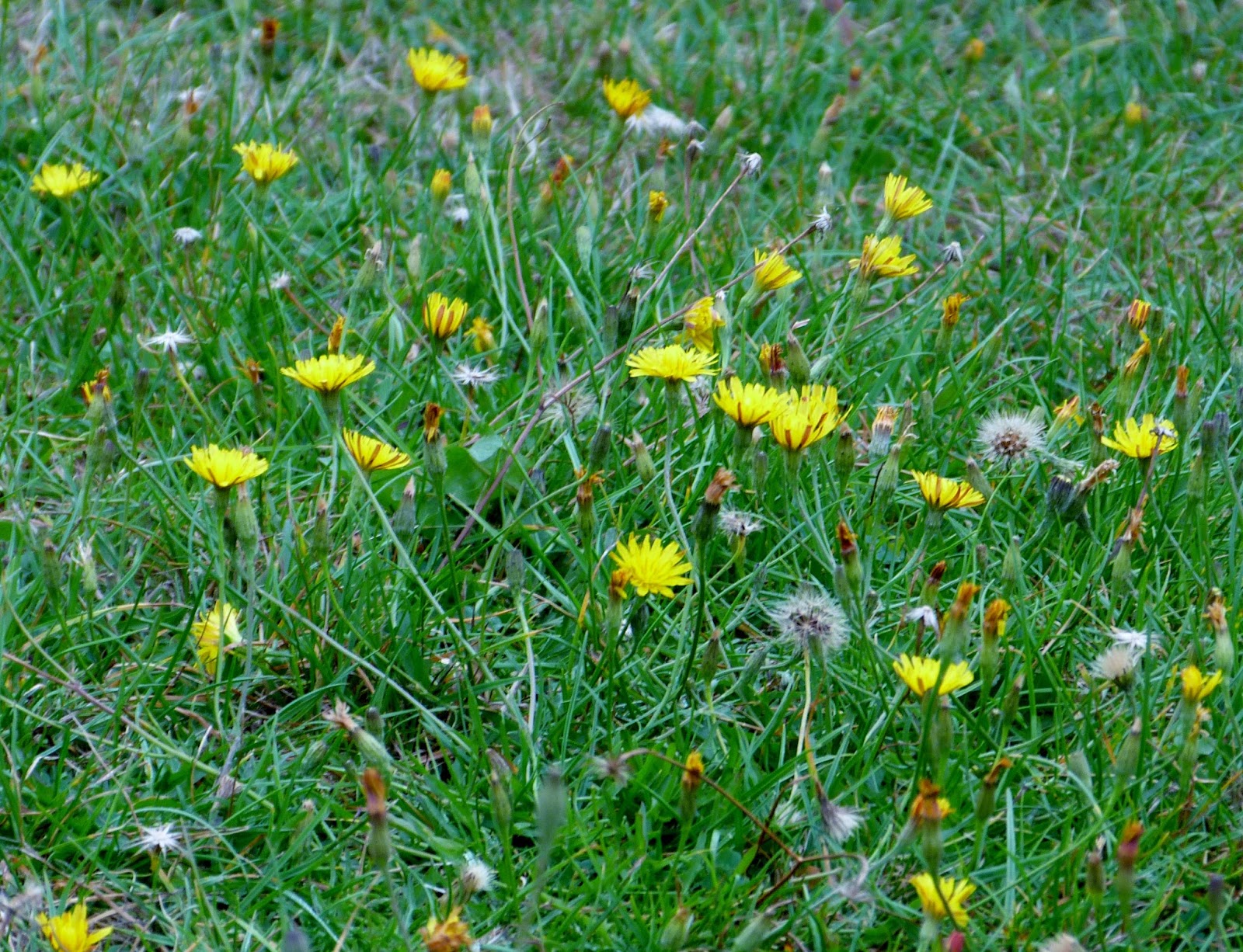
Elsewhere in Lewisham, a few Swallows have been seen which means they're probably starting to think about heading south. And in other news, blackberries are ripening again after having had just the right amount of sunshine and rainfall in the last few weeks. I haven't sampled the Hilly Fields crop, but tried some at the RSPB Rainham reserve in Essex and they were delicious. On the park grassland, buttercups have given way to swathes of little dandelion-like flowers. These have been identified for me by Nick Bertrand (ace Creekside Centre botanist) as Autumn Hawkbit. Taken together, all these signs can mean only one thing. The last days of summer are upon us.
Postscript 3rd September: heard a Chiffchaff singing again on Eastern Road this morning. I mentioned last month that a pair of Chiffchaffs had produced at least one youngster on Hilly Fields this summer. It's possible that they could overwinter here, but more likely that they'll be off back to the Med in 2-3 weeks time. And who can blame them?
We saw only one Blackbird which is unusual and heard the occasional Goldfinch. Three House Sparrows, two Ring-necked Parakeets and a Feral Pigeon made up the total. The week before, Sue had seen even fewer birds but had at least the excitement of watching a Sparrowhawk being chased by a Crow! Before going for a coffee at the cafe, we took a look at a recently vacated Robin's nest just inside the bothy gates which Lee the park keeper had pointed out to us - a cup nest created in thick ivy against a wall. I wonder how many chicks were born here and how many survived?
Elsewhere in Lewisham, a few Swallows have been seen which means they're probably starting to think about heading south. And in other news, blackberries are ripening again after having had just the right amount of sunshine and rainfall in the last few weeks. I haven't sampled the Hilly Fields crop, but tried some at the RSPB Rainham reserve in Essex and they were delicious. On the park grassland, buttercups have given way to swathes of little dandelion-like flowers. These have been identified for me by Nick Bertrand (ace Creekside Centre botanist) as Autumn Hawkbit. Taken together, all these signs can mean only one thing. The last days of summer are upon us.
Postscript 3rd September: heard a Chiffchaff singing again on Eastern Road this morning. I mentioned last month that a pair of Chiffchaffs had produced at least one youngster on Hilly Fields this summer. It's possible that they could overwinter here, but more likely that they'll be off back to the Med in 2-3 weeks time. And who can blame them?
Wednesday, 16 January 2013
Black Caps and Red Wings
I mentioned the sighting of a female Blackcap on Hilly Fields in my "December Bird Survey" post. Since then, this little bird has made the national press and television (well, the Independent and BBC's Winterwatch at least) and it's all due to the British Trust for Ornithology. The BTO has initiated a January Blackcap garden survey, details of which can be found on their website: http://www.bto.org/. It has also produced evidence that Blackcaps which winter in the UK are not - as I confidently asserted - staying on after the spring migratory flocks return to Spain and North Africa in autumn, but are part of a separate population from Central Europe - particularly Germany. Whereas in the past, these birds have gone south from Germany in autumn, they now prefer to spend their winter vacation here (see the yellow arrow in the diagram below).
"What?!" I hear you say. "They prefer Britain to the Med! Talk about bird-brained..." But they've discovered that it's warm enough here and, even better, their return journey is much shorter, allowing them to get back quickly to Germany in the spring and nab the best nesting sites. Not so silly after all, eh? "We have a new winter bird" is how Michael McCarthy put it in the Independent. And the upshot for us is that we will have year-round Blackcaps in Hilly Fields, albeit not in great numbers. Their use of garden feeders is on the increase and if you have one, it is worth doing the BTO survey. In my experience, the feature that stands out in the Blackcap is its pale grey breast. Once you've seen that, check if they have a black head (male) or chestnut brown (female). Here's a close-up clip of a male:
Redwings are another species which winter in the UK, arriving in their thousands from Scandinavia. Members of the Thrush family, they have speckled breasts but the main distinguishing features are red patches on their sides and a white stripe over each eye. Yesterday we did a special mid-month survey of Hilly Fields prior to our Big Birdwatch event (Sunday 27 January at 10.30) and saw four of them which is the first sighting on HF since Keith recorded a small flock of seven two years ago.
In addition, we saw 30+ Starlings, 17 Goldfinches, 15 Wood Pigeons, 11 Common Gulls, lots of Great Tits, Blue Tits and Robins, Crows, Magpies, Blackbirds, Greenfinches, Chaffinches, Mistle Thrushes, House Sparrows and one each of Jay, Ring-necked Parakeet, Wren, Feral Pigeon and Black-headed Gull. A total of 20 species which augers well for the (stop me if I've mentioned this before) Big Birdwatch event on Sunday 27 January at 10.30. Incidentally, there seemed to be a growing awareness amongst some birds yesterday that the mating season is getting closer. Certainly, this Robin was singing very lustily in Hilly Fields Wood...
"What?!" I hear you say. "They prefer Britain to the Med! Talk about bird-brained..." But they've discovered that it's warm enough here and, even better, their return journey is much shorter, allowing them to get back quickly to Germany in the spring and nab the best nesting sites. Not so silly after all, eh? "We have a new winter bird" is how Michael McCarthy put it in the Independent. And the upshot for us is that we will have year-round Blackcaps in Hilly Fields, albeit not in great numbers. Their use of garden feeders is on the increase and if you have one, it is worth doing the BTO survey. In my experience, the feature that stands out in the Blackcap is its pale grey breast. Once you've seen that, check if they have a black head (male) or chestnut brown (female). Here's a close-up clip of a male:
Redwings are another species which winter in the UK, arriving in their thousands from Scandinavia. Members of the Thrush family, they have speckled breasts but the main distinguishing features are red patches on their sides and a white stripe over each eye. Yesterday we did a special mid-month survey of Hilly Fields prior to our Big Birdwatch event (Sunday 27 January at 10.30) and saw four of them which is the first sighting on HF since Keith recorded a small flock of seven two years ago.
In addition, we saw 30+ Starlings, 17 Goldfinches, 15 Wood Pigeons, 11 Common Gulls, lots of Great Tits, Blue Tits and Robins, Crows, Magpies, Blackbirds, Greenfinches, Chaffinches, Mistle Thrushes, House Sparrows and one each of Jay, Ring-necked Parakeet, Wren, Feral Pigeon and Black-headed Gull. A total of 20 species which augers well for the (stop me if I've mentioned this before) Big Birdwatch event on Sunday 27 January at 10.30. Incidentally, there seemed to be a growing awareness amongst some birds yesterday that the mating season is getting closer. Certainly, this Robin was singing very lustily in Hilly Fields Wood...
Tuesday, 4 September 2012
August Bird Survey
The upper half of Eastern Road and the adjoining wood/nature reserve could almost be designated an AONB (Area of Outstanding Natural Birdwatching) within Hilly Fields. Apart from the winter Gulls (and, come to think of it, the House Sparrow), almost every bird that frequents the park can be seen there at some time or other and it's particularly favoured by the smaller birds such as Tits, Finches, Blackcaps, Robins, Wrens and by Blackbirds. Obviously the number of trees is a big attraction, as is the cover provided by the sheer density of foliage, particularly the hawthorn scrub on the western side of the road. And at this time of year, the bright red haw berries provide a food source.
Eastern Road also contributes one of the few sources of water for birds on Hilly Fields. On this month's survey (24 August), we watched a small flock of adult and juvenile Goldfinches along with a couple of Greenfinches swoop down from the roadside trees to drink from puddles in the gutters and little potholes - a sight we've often noted before. In the wood, we heard a couple of Robins singing for the first time since late spring - a sure sign that they're emerging from the summer moult. Wrens were singing there too. And flitting among the trees on the eastern side of Eastern Road was our old friend the Great Spotted Woodpecker, not seen since early June. In this full zoom photo, you can just about make out its black, white and red colouring.
Elsewhere in the park, we saw Great Tits, Blue Tits, Blackbirds, Magpies, Crows, Feral Pigeons, House Sparrows, Ring-necked Parakeets and Wood Pigeons. In addition, Sue intended to listen to her birdsong CDs to determine whether the "chink" (or was it "pink"?) we heard could have been a Chaffinch calling. This makes a reasonably wide range of species, albeit in small numbers apart from the "Woodies". Still no sign of any Starlings. Earlier in the month, I saw a pair of Mistle Thrushes in the Eastern Road hawthorns and a Jay in the poplars along the Stones Field boundary, so it's good to know they're still around.
Meanwhile, in other news, something is coming to fruition along Eastern Road - yes, it's also an Area of Outstanding Natural Blackberrying. If you haven't been along there with your bowl yet, now's the time.
| Blackbird in Hilly Fields Wood |
Elsewhere in the park, we saw Great Tits, Blue Tits, Blackbirds, Magpies, Crows, Feral Pigeons, House Sparrows, Ring-necked Parakeets and Wood Pigeons. In addition, Sue intended to listen to her birdsong CDs to determine whether the "chink" (or was it "pink"?) we heard could have been a Chaffinch calling. This makes a reasonably wide range of species, albeit in small numbers apart from the "Woodies". Still no sign of any Starlings. Earlier in the month, I saw a pair of Mistle Thrushes in the Eastern Road hawthorns and a Jay in the poplars along the Stones Field boundary, so it's good to know they're still around.
Meanwhile, in other news, something is coming to fruition along Eastern Road - yes, it's also an Area of Outstanding Natural Blackberrying. If you haven't been along there with your bowl yet, now's the time.
Subscribe to:
Posts (Atom)