Showing posts with label Dunnock. Show all posts

Saturday, 6 August 2016

Silence of the Birds

We were greeted by silence at the lower Vicars Hill Gate on 27 July, at least as far as birdsong is concerned. Traffic was light on the road and, for a minute or two, all that could be heard was the sound of raindrops plopping down from leaf to leaf in the plane trees. It was evident that we had reached the end of the breeding period and entered that quiet season when most birds rest and moult. We began our circuit of the park and although we had a few brief sightings and soundings, things remained uneventful until we reached the upper part of Eastern Road.


Here we saw a small sparrow-like bird scavenging on the roadway which had clearly lost its tail. From its grey head and thin bill, we realised it was a Dunnock - a bird once better known as the 'Hedge Sparrow' although the two species are not related. I would guess that it was a juvenile which had had a close encounter with a predator - a bigger bird or possibly even a squirrel or cat. No worries - it survived. And as a bird's tail is composed entirely of feathers, it will soon grow back again. We see or hear Dunnocks often on Hilly Fields but rarely out in the open like this. They are skulking birds, usually glimpsed in the undergrowth where, unexpectedly perhaps in view of their drab appearance, they lead adventurous sex lives which 'might make Russell Brand blush.'

Female Blackbird: Upper Eastern Rd
Also scavenging on this stretch of road were a family of 4 Blackbirds, presumably the same adults that we saw last year but with different juveniles.  Blackbirds are scrub nesters, ie. they favour bushes and small trees. Upper Eastern Road with its thick vegetation, bramble bushes and hawthorns is ideal habitat for them and, with all the berries and orchard fruit nearby, is almost like nesting in a larder. We also caught a brief glimpse of a Song Thrush further up the road which is only our second sighting this year.

Song Thrush: stock photo
Elsewhere, Wrens sang occasionally and we heard a few wistful snatches of Robin and Blackbird song and both saw and heard a pair of Goldfinches. We may have heard a brief snatch of Blackcap song at one point but were not sure enough to record it. The final list included 7 Woodpigeons, 2 each of Blue Tit, Crow and Magpie and singles of Great Tit, House Sparrow and Parakeet in addition to the birds already mentioned. A total of 13 species in all - a fair drop from last month, but identical to last year's July figure and only one less than July 2014.

Friday, 4 March 2016

Gearing Up

Sun with very little wind made ideal conditions for our monthly bird survey on 24 February. And the birds seemed to appreciate it too. There was a great deal of activity going on as they gear up for the breeding season with much calling, singing and flitting about, especially among the small birds - the Tits, Wrens and Robins. Dunnocks were heard singing in several areas and finally seen in the garden next to the bowling green where the photo below was taken. The Dunnock is a sparrow-like bird (it used to be called the Hedge Sparrow) with similar chestnut-brown streaks, but has more grey around the head and a thinner beak. Difficult to spot most of the year as it creeps around in the undergrowth, but in late winter/early spring. it will often sing from a tree branch with a sweet rhythmic warble.

Dunnock
A small group of Long-tailed Tits were seen on upper Eastern Road, one carrying a feather in its beak - obvious nesting material. We saw a pair of Mistle Thrushes on the grass in the East Field, a Jay which judging by its direction had flown over from the cemetery and a small flock of Starlings which moved around the park from tree to tree. It was good also to see our old friends Mr and Mrs Great Spotted Woodpecker in the little wood by Eastern Road. Both were perched on the tall bare tree by the green gates on Eastern Road, though the male flew out of the picture below just before I pressed the button/ The male has a red patch on the top of the head, the female doesn't. You can see where she's been pecking at the bark searching for insects.

Female Great Spotted Woodpecker

The grand total was 12 Wood Pigeons, 11 Robins, 10 Starlings, 8 House Sparrows, 5 each of Dunnocks and Wrens, 4 each of Crow and Long-tailed Tits, 3 each of Blackbird, Blue Tit, Great Tit and Parakeet, 2 each of Feral Pigeon, Great Spotted Woodpecker, Magpie and Mistle Thrush and 1 each of Black-headed Gull, Chaffinch, Collared Dove, Common Gull, Goldfinch and Jay - 22 species in all.

Puffed-up Woodpigeon basking in the sun
This is a good point to give you advance notice of our annual Dawn Chorus walk. This year it will be on Thursday 31 March, meeting at 6 am outside the cafe. As in previous years, we'll spend an hour walking around Hilly Fields listening to and looking at the birds. Then we'll go down the hill to the Brockley and Ladywell cemeteries to repeat the exercise there. If you only want to attend the cemeteries walk, be outside the double gates on Brockley Grove near the chapel at 7am.


Tuesday, 2 February 2016

Big BirdWatch 2016

Rain is the curse of bird surveys. It deters the birds from coming out to play and blurs the vision, especially through binoculars and spectacles. So Sunday wasn't the greatest Birdwatch ever! The rain was light but the morning was damp, grey and overcast for the most part. Still, enough people turned up to make it a worthwhile event. Starlings were the stars of the count, seen by most people as they flew noisily in little flocks from trees to trees. 42 was the maximum number recorded. The Black-headed Gulls around the cricket pitch were runners-up with a count of 29. Full stats can be seen on the blackboard below.


 We recorded a total of 19 species in all and had good views of a charm of Goldfinches outside the school and a Dunnock scrabbling around on the ground. We heard a Dunnock singing as well for the first time this year. Towards the end, the sun did fleetingly show itself and a pair of Mistle Thrushes spent some time in the trees opposite the cafe. All you need is to see one beautiful bird thriving in the park like this and it's all worthwhile.


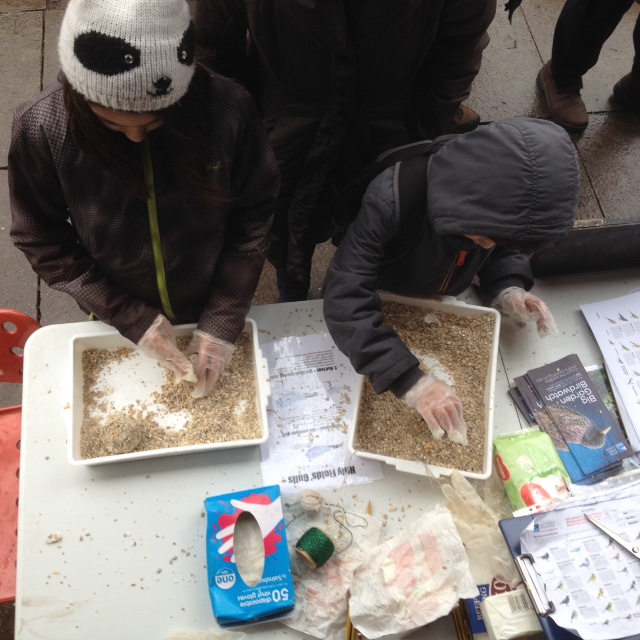
One big plus was to see so many children brought along by their parents. They all had an enjoyably messy time making fat balls and bird feeders throughout the morning. Thanks to Rachel for organising the stall and publicity, to Sandy for helping on the stall, Judith from Glendale for the photocopying (and bringing her mum!), Sue and Keith for helping to lead the guided walks and Lee the park keeper for general support. Here's to next year and hopefully some decent weather. That's not too much to ask, is it?


Thursday, 5 March 2015

A Bit of Parakeet Cheek

Our monthly survey on 25 February got off to a great start when we spotted a woodpecker in trees along the Veda Road border. Yes, folks, it was a Great Spotted Woodpecker - a female as it lacked the male's red patch behind the head.


Later, we discovered that last year's woodpecker nest (see here) has been commandeered by a pair of parakeets who start breeding earlier than the other birds. If you walk due south from the front of the cafe with the tennis courts on your right, there is a traffic barrier and to the left of that an ash tree. The nest is in a hole (which the parakeets have widened a little) about 20 feet up the tree. To the best of our knowledge, we have only one pair of woodpeckers in the park and they generally choose a different site every year so war is unlikely to break out. But it's a bit of parakeet cheek. I bet they never asked...


The small birds were all very active as we would expect given it's their mating season. Great Tits were the most vocal, but Robins and Wrens were also singing loudly. While most of the tits and finches were flitting around, a Greenfinch sat still for quite some time in the top branches of a tree on upper Eastern Road, evidently enjoying the sunshine.


Counting the gulls on the cricket field was difficult as they came and went, but we estimate 50 Common Gull (yellow bill and legs) and 8 Black-headed Gull (Red bill and legs). Hilly Fields is one of the few sites in Lewisham where Common Gulls congregate in such numbers. Sue saw a pair of Collared Doves which is unusual in the park. And just when we thought it was all over and were refreshing ourselves outside the cafe, we saw a pair of Redwings in the trees next to the basketball court. These are thrushes which winter here from Scandinavia and have a patch of red under the wing, hence the name.


In addition to the birds already mentioned, we saw 12 Starlings, 9 House Sparrows, 6 Feral Pigeons, 5 Woodpigeons, 5 Crows and 5 Dunnocks, 3 Blackbirds, 2 each of Blue Tit, Chaffinch, Long-tailed Tit and Magpie and 1 each of Mistle Thrush and Goldfinch - making an impressive 23 species in total. Incidentally, 5 Dunnocks is a new record for Hilly Fields and two of them engaged in a mid-air courtship display which involved flapping their wings at each other. All in all, a busy and rewarding morning.

Thursday, 5 December 2013

The Gulls Have Landed

We were joined by Judith from Glendale for our monthly survey on 25 November. Judith helps to manage the Lewisham bird champion scheme and also assists at our annual Big Birdwatch event (for news of which see below). There wasn't anything exciting to show her such as woodpeckers or birds of prey or a partridge in a pear tree, but we found 16 different species including most of the regulars and a couple of irregulars. The latter consisted of a Dunnock flitting around in the bushes at the back of the bowling green and a small flock of at least 5 Greenfinches seen in the Eastern Road area.

Greenfinches [stock photo]
Perhaps the most significant event, however, is the return of the Gulls for their winter residence on Hilly Fields. Only 10 were counted on this occasion but the number will increase as winter progresses and, based on past experience, they will be with us until early April. The gull most often seen in London (and in Lewisham) is the Black-headed Gull, but Hilly Fields bucked the trend last year with a higher proportion of Common Gulls present. That seems set to continue as eight of those we saw in November were Common and only two were Black-headed. How do you tell them apart? The Black-headed Gull has a red bill and legs, the Common Gull has a yellow bill and legs. The Black-headed Gull has a black spot next to its eye in winter, the Common Gull doesn't. The name 'Black-headed Gull', by the way, is misleading. It has a white head in winter and even in its spring/summer breeding plumage, the head is dark chocolate brown rather than black. These things are sent to test us.

Common Gull left, Black-headed Gull right
Elsewhere around the park, we heard plenty of Robins singing and occasionally saw one, the full complement of 10 House Sparrows was present in the Cliffview hedge, the Blue and Great Tits were active in the trees and a flock of at least 10 Goldfinches flew over. The rest of the list: 5 Blackbirds, 4 Crows, 4 Woodpigeons, 3 each of Feral Pigeon, Magpie and Ring-necked Parakeet and a solitary Chaffinch. And also elsewhere in the park, mysterious 'fairy rings' of storm-damaged tree stump have been appearing. I don't suppose the Friends of Hilly Fields could have had anything to do with this?


RSPB BIG BIRDWATCH 2014
Time marches on and we will soon be holding our annual Big Birdwatch event at Hilly Fields to coincide with the RSPB's Big Birdwatch weekend. Our event will be held by the cafe on Sunday 26 January between 11.00 - 14.00. You can either pick up a bird guide sheet from our stall and do your own survey or come round on one of our guided bird-spotting tours. We will also be offering activities for children and a fun bird quiz! Hope to see you then.

Tuesday, 5 November 2013

After the Storm

Our October survey took place a day after the so-called St Jude's storm. By then, the wind had dropped, the clouds were white and fluffy and there was even some blue sky and sunshine. When we entered the park halfway up Vicars Hill and saw a Dunnock sitting on a branch in the border scrub, I knew we were in for a good morning. This is the area where we heard it singing in the spring and is presumably its main territory. Seen from below, the Dunnock appears rather nondescript and similar to a House Sparrow. In silhouette, however, a needle-point bill can be seen quite unlike the chunky beak of the sparrow. Although the Dunnock is still sometimes called the 'hedge sparrow', the two birds are completely unrelated.

Dunnock in the Vicars Hill border
We were then distracted by a small gang of Blue Tits chasing each other at high speed around the trees and performing their usual acrobatics among the branches. This reoccurred elsewhere and was probably a release of pent-up energy after the end of the moulting period. On the eastern wall of Prendergast School, a rainwater gully attracted the Tits attention, perhaps as a drinking and dunking hole. A Pied Wagtail was also spotted nearby. Great Tits were out and about and were even heard calling although rather faintly. They don't normally get into their two-note stride until after Christmas. Among the Eastern Rd hawthorns we were pleased to see a small flock of Long-tailed Tits which are also fast and agile movers. The RSPB Handbook's description of them as 'restless' seems pretty accurate.

Blue Tit inspecting the drains
Another highlight was the sighting of both male and female Great Spotted Woodpeckers in the Eastern Rd area. How can you tell them apart? The male has a red cap at the back of its head, the female doesn't (see photo here). Both have bright crimson feathers under the tail and all juveniles have a red patch at the front of the head (see below) which disappears with the first moult. In total, we counted 19 species during our walkabout. As well as those already mentioned, we saw or heard at least 15 Wood and 6 Feral Pigeons, 7 House Sparrows in and around the Cliffview hedge, at least 5 Robins calling, 5 Crows, 2 Magpies and 2 Blackbirds. We also heard a Chaffinch, a Goldfinch, a Ring-necked Parakeet, at least one Wren and caught brief glimpses of a Mistle Thrush and a Starling. The Starlings have not yet returned in force from the outer suburbs but should be back soon along with the Black-headed and Common Gulls.

Woodpecker nestling in 2012
As for the storm, what damage has it caused on Hilly Fields? Several trees have been felled including, sadly, one of the two crack willows on the south slope. Lots of branches and whole limbs have been broken off including one in which our Great Spotted Woodpeckers nested in 2012. On the whole, though (and despite the dramatic looking photos below), St Jude's storm wasn't in the same league as the great overnight storm of 1987 which killed 18 people in England, felled an estimated 15 million trees and of course immortalised a certain weatherman.


One of the two crack willows on the south slope
The Woodpeckers' nesting tree in 2012

Thursday, 4 April 2013

Dawn Chorus Walk - Hilly Fields/Brockley and Ladywell Cemeteries

This years dawn chorus walk will take place on Thursday April 11 starting at 6am. This is an hour later than usual (by public demand), but should still be close to dawn as the clocks went forward last weekend. We will meet outside the cafe on Hilly Fields, walk around the park and then go on to Brockley and Ladywell Cemeteries which together are listed as a Grade 1 Site of Borough Importance for nature conservation purposes.

Birds we can expect to hear on Hilly Fields include Blackbird, Robin, Wren and probably one of the Dunnocks which have been vocalising frequently in the last few weeks. In addition, we should hear Magpies chattering, Crows crowing, Blue Tits/Long-tailed Tits tseeping and, almost certainly, that 'Johnny Two Note' - the Great Tit. If we're lucky, we may hear a Mistle Thrush singing (seen but not heard so far this year) or a Great Spotted Woodpecker drumming its bill against a tree trunk.

Mistle Thrush in one of the Eastern Road hawthorns, 24 March
In the Brockley and Ladywell Cemeteries, we may hear a Song Thrush (as we did last year) and see/hear a Green Woodpecker and Britain's smallest bird, the Goldcrest. We may also catch a glimpse of one of the Sparrowhawks which have nested there in recent years. If a 6.00 am start is too horrific to contemplate, we will be entering the cemeteries at 7.00 am via the side gates on Brockley Grove which are opposite house no. 212 and between Amyruth and Henryson Roads. You are welcome to join us there. Please bring binoculars if you can. The walk will finish by 8.00 am but you can drop out at any stage.

Just time for a brief mention of the March bird survey which Terry and I carried out on the 28th of last month. The birds were a little quieter than usual but by the end of our walkabout, we had seen or heard 18 species. It was good to see a small flock of Redwing in the south field, to hear a pair of Dunnocks serenading each other and to see Chaffinches, Long-tailed Tits and Mistle Thrushes. The north field held a flock of about 60 gulls with Common Gulls again living up to their name and outnumbering the Black-headed Gulls by 2:1. However, the Black-headed Gulls are also living up to their name and have developed their 'black' heads (actually a dark chocolate colour) which makes it dead easy to tell the two different types apart. This is their breeding plumage and they will soon be off elsewhere to look for nest sites and partners.

Black-headed Gulls, Hilly Fields, 18 March
In addition to the above, we also saw and/or heard Wrens, Magpies, Blue Tits, Great Tits, Wood Pigeons, Robins (all over the place), Crows, House Sparrows, Greenfinches, a Great Spotted Woodpecker and, last but least, a lone Parakeet.

Friday, 28 December 2012

December Bird Survey

Our December bird survey took place on the 21st - a fine sunny day though the ground was still rain sodden in places. It was also the winter solstice, the shortest day of the year and, according to some, the day on which the world would end - although the Mayans were saying that was baloney. And of course they were right.

The better weather brought plenty of birds out, but the highlight was a clear view of a female Blackcap in the garden between bowling green and bothy. Blackcaps are warblers with a pretty song which we heard often last spring. They are still mainly spring migrants to the UK and spend the winter in Spain, Portugal or West Africa, but as our climate has warmed, a small population overwinters here (estimated as "3000 and increasing" by the RSPB). By coincidence, Sue had seen a male Blackcap in her garden a few days earlier, so it is gratifying to know that they are hanging on in lovely Lewisham. The male has a black head (hence the name 'Blackcap') and the female a brown head; both have a light grey breast. Our female didn't stay around long enough for me to get a photo, but here's one from the Web.

Female Blackcap
Just before the Blackcap appeared, we saw a Dunnock (possibly two) scrabbling around in the undergrowth. Dunnocks seem to be permanent residents of Hilly Fields, though we've never seen more than one or two at any one time and I doubt that there are many around the park. They are small, furtive birds that tend to creep around close to cover.

Dunnock
In all, we saw 17 different species during our walkabout. The 'big' numbers were 22 Blackheaded Gulls, 13 Starlings, 10 Woodpigeons and 9 Common Gulls. There were 6 House Sparrows in the Cliffview hedge which is slightly more than usual. We heard the high-pitched trilling of Goldfinches quite often, but never saw more than 4 together. Similarly, we heard and saw Robins, Great Tits and Blue Tits galore but never more than 3 at any one time. We also saw small numbers of Magpies, Crows, Blackbirds and Ring-necked Parakeets as well as a solitary Chaffinch and at one point heard a Greenfinch sneering at us from somewhere out of sight. Here's a shot of one of the Starlings high up in a poplar tree -they really do have attractive glossy speckled coats though you need a close-up view to appreciate it.


In other news, the Tawny Owl was heard again earlier this month by a Cliffview resident (thanks, Keith!).  Great Tits which have been quiet since early summer can now be heard calling most days and other birds should be getting more vocal from January onwards. On which 'note', may I thank everyone who takes the time to visit and read (and occasionally comment on) Hilly Fields Birdwatch and wish you all the best for 2013.

Thursday, 19 May 2011

Hilly Fields Dawn Chorus walk

Over a dozen insomniacs joined Chris McGaw of Rivers and People Project for this dawn chorus stroll around the park, and we were well rewarded.
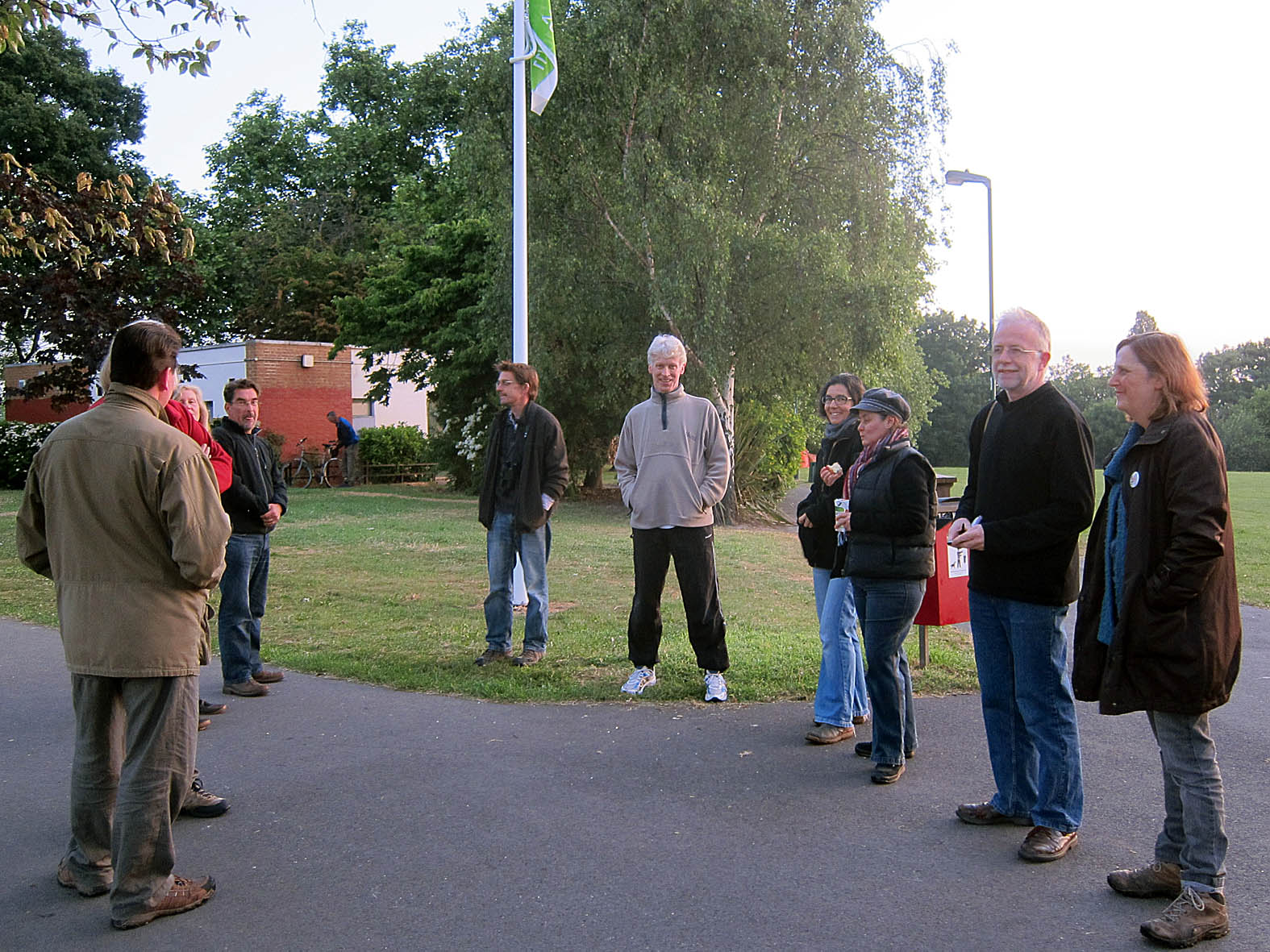
Some of the 5am insomniacs


Full moon over the Nature Reserve
As we made our way towards the Nature Reserve we had a glorious full moon in front of us and the rising sun behind.
Sun rising over Lewisham
We heard Wren, Blackbird, Woodpigeon and Ring-necked Parakeet in the Nature Reserve but the most notable was the Blackcap.


Later, on the road past the school we stopped to admire the Long-tailed Tits, Goldfinches, a Chaffinch and also heard a Dunnock.

Chaffinch beside the school
On the west side of the North Fields there was a flock of 10 Magpies then, beside the cricket pitch with some Woodpigeon were a pair of Stock Doves and, on the hillside behind them, three Mistle Thrush.

We are all very grateful to Chris for this morning's wonderful walk and look forwards to another next year.  Let's hope the proposed cafe will be open in time for a welcome cuppa then!
We saw or heard 20 species this morning, for a complete list click below:

Tuesday, 25 May 2010

Another Waterlink Way Dawn Chorus

We're lucky Chris McGaw was pursuaded to repeat his dawn chorus walk of Waterlink Way today.  On the plus side it was 8 to 10 degrees warmer this morning than three weeks ago, on the other hand we started half-an-hour earlier!

Nine of us managed the 5am start, three had been on one of Chris' other dawn chorus walks whereas six were new to the experience. 
Birds we heard (but I didn’t see):

  • Blackcap *
  • Blue Tit
  • Cetti's Warbler *
  • Chaffinch
  • Chiffchaff *
  • Great Tit
  • Greenfinch
  • House Sparrow
  • Lesser Whitethroat *
  • Reed Warbler *
  • Robin
  • Song Thrush *
  • Stock Dove *
  • Swift
  • Whitethroat *
  • Wren *
Birds I saw and heard
  • Blackbird
  • Carrion Crow
  • Dunnock
  • Goldfinch
  • Great Spotted Woodpecker
  • Greenfinch
  • Magpie
  • Moorhen *
  • Ring-necked Parakeet
  • Starling
  • Woodpigeon
Birds I saw (but didn’t hear)
  • Collared Dove *
  • Feral Pigeon
  • Grey Wagtail *
  • Jay
  • Kestrel
  • Long-tailed Tit
  • Mallard *
* Birds never seen (by me) in Hilly Fields

Being warmer than last time I was able to take a few notes about some of the birdsong, I just hope I can remember them for future reference:
  • Cetti's Warbler: an explosive metallic song;
  • Blackcap: like a speeded-up blackbird;
  • Chaffinch: a bowler running up to the crease with a final flourish;
  • Wren: piercing with a trill near the end;
  • Dunnock: an even sounding warble like a wren but with no trill;
  • Greenfinch: a wheezing sound;
  • Robin: song is sad, alarm is a tick-tick;
  • Whitethroat: a non-musical scratchy warble;
  • Woodpigeon: 5 notes with stress on the 2nd;
  • Collared Dove: 3 notes with stress on the 2nd;
  • Stock Dove: a cyclical series of notes.
I didn't stay for the cup of tea and chat at the end as there was to be a Green Flag inspection of Hilly Fields park later and I wanted to be there if I could.

Wednesday, 5 May 2010

Waterlink Way Dawn Chorus

I'm a night owl, not an early bird, so to ensure that I got to Sainsbury’s in Bell Green by 05:30 I had to stay up all night.  That's how, yesterday morning at 5degC and in a northerly wind, I met Chris McGaw and seven others for his Dawn Chorus Walk along Waterlink Way. Chris runs the Rivers and People Project for Lewisham Council and his birdsong identification skills are amazing.

Our first stop was the Pool River immediately behind the store. Within just a few minutes the number of birds whose song Chris had identified was into double figures. If you ever get the chance to join one of his dawn chorus walks, don’t hesitate.

Most of the birdsong was heard on the first half of the walk, by the time we arrived at the confluence with the Ravensbourne River the sun was up and many of the birds had quietened down. We finished at the environment centre, whose name I forget but it used to be the southbound waiting room of Ladywell station, for a very welcome hot drink, biscuits and fruit. I returned by 75 and 181 buses to pick up my car. At 05:15 it took 10 minutes to drive there, at 08:20 it took 40 minutes to drive home!

Birds we heard (but didn’t see):
  • Cetti's Warbler *
  • Chaffinch
  • Chiffchaff *
  • Collard Dove *
  • Dunnock
  • Greenfinch
  • House Sparrow
  • Lesser Whitethroat *
  • Reed Warbler *
  • Song Thrush *
  • Woodpigeon
  • Wren

 Birds we saw and heard
  • Blackbird
  • Blackcap *
  • Blue Tit
  • Carrion Crow
  • Great Tit
  • Long-tailed Tit
  • Magpie
  • Mallard *
  • Moorhen *
  • Ring-necked Parakeet
  • Robin
  • Starling
  • Whitethroat *

Birds we saw (but didn’t hear)
  • Feral Pigeon
  • Grey Heron *
  • Herring Gull *
  • Jay

* Birds never seen (by me) in Hilly Fields

Forgive me for posting info unrelated to Hilly Fields, but it IS a local birdy blog!

Saturday, 30 January 2010

Two more species sighted on Big Garden Birdwatch

We were so lucky with the weather being dry, bright and sunny with little wind.  However, it was only just above zero.  Last year's 20 species record was not beaten, but we did sight three species not recorded in Hilly Fields for over 2 years (see below).
There were a good number of visitors and I took parties of five or six at a time around the park to see what we could find.

I was quite surprised not to find any birds at all in the South Field, Meadow or West Field (compared with two days ago) and very few around School area.  Sports were being played in the North Field so none were spotted there either.  The vast majority were to the south of the Stones Field and east of the East Field (i.e. along the Cliffview Road hedge).
This is the result:

Blackbird (2)
Blue Tit (2)
Carrion Crow (3)
Chaffinch (3)
Coal Tit (2) - First sighting
Common Gull (1)
Dunnock (1) - First sighting
Feral Pigeon (2)
Goldfinch (2)
Greenfinch (2)- First sighting
Great Tit (3)
House Sparrow (11)
Long-tailed Tit (2)
Magpie (2)
Mistle Thrush (2)
Redwing (1)
Robin (1)
Starling (1)
Woodpigeon (4)

[Correction on 01/02/2010: The Dunnock was previously omitted from this list (my error), and today I've seen one in my garden, a mere 50m from where we spotted it on Saturday.]

Long-tailed Tit

We are all indebted to Vicki Wheeler, Nature Conservation Officer, for organizing the event - especially the tea, coffee and biscuits which were certainly needed after wandering around the park in such cold weather.  With Vicki's help, our younger visitors made birdfeeders from pots, lard and birdseed to take home and hang up in their own gardens.