Showing posts with label Kestrel. Show all posts

Friday, 3 January 2025

Hilly Fields Big Birdwatch 2025

 Our annual Hilly Fields Big Birdwatch event will be held on Sunday 26 January this year from 10.30-12.30. As usual, we will have a stall outside the cafe which will have bird ID sheets if you wish to go round the park on your own or you can use them on the guided walk which will start at 11.00. Our celebrated Big Blackboard will be there to display the results. 

Children will be able to make fatballs and bird feeders at the stall and these can be hung from trees in the park or on trees in your street or garden. Loop them over low hanging branches and you will be helping  birds to get through the winter.


We will also have copies of our 'indispensable' guide to the Birds of Hilly Fields with pen portraits of all species recorded in the park since 2007 and many photographs. These are priced at £5 and all money received goes to the Friends of Hilly Fields to help with nature conservation projects.

Our birdwatch is organised by the Friends of Hilly Fields, in conjunction with Glendale, the Lewisham Parks maintenance team. It is timed to coincide with the nationwide RSPB Bird Garden Birdwatch. In counting birds for this event, please remember the RSPB's golden rules:

(i) only count the maximum number of each species that you see at any one time (to avoid duplication); (ii) don't count birds that fly over without stopping - only birds within the park. 

By the way, back in November we were lucky enough to see a kestrel in the park – a rare event these days. It was perched in one of the horse chestnut trees in the north field, watching a flock of sparrows flitting about in some trees below. At one point, it left its perch and hovered in the air above them, but no sparrows were taken as far as we could see. 

We look forward to seeing you on 26 January.

Wednesday, 6 August 2014

Return of a Predator

Due to various commitments and crises, Sue and I ended up doing the July bird survey at 4.15 pm on 31 July. Afternoons are not normally the best time for bird watching and we had low expectations about what we'd find. And when we began our circuit around the park, our fears seemed to be borne out. The Vicars Hill and Veda Road borders were virtually silent. We spotted a Magpie and heard the faint churr of a Blue Tit from somewhere, but things were not looking or sounding good. In the little wood, we saw a Robin and heard a Parakeet. On the upper part of Eastern Road, we heard a Greenfinch and saw a small flock of about 5 Goldfinches.


Then, from the brow of the hill between Eastern Road and the school, Sue spotted a predator flapping away eastward, a dark shape difficult to identify in the few seconds that it was visible. A Sparrowhawk? Maybe. We carried on, feeling a little frustrated...but not for long. As we approached the slope above the wildflower meadow, Sue spotted the bird landing on one of the lime trees that border Adelaide Avenue. Soon after, it began an aerial tour of the south slopes and our predator became identifiable. A Kestrel! A female, in fact, and the first one that we'd seen at Hilly Fields since February 2012.


For the next forty minutes, we watched as it circled around, sometimes hovering with rapid wingbeats in that distinctive way Kestrels have, at other times gliding with wings outstretched. At one point, it perched on a tree for a short while and I was able to get some decent pics through the zoom lens. The focus of its attention was the long grass in the south meadow where it would have been looking for field mice and voles. Several times, it swooped down into the grass, but didn't appear to catch anything other than maybe a few invertebrates. A Crow and a Magpie arrived to hassle it at different times, but it simply flew higher and carried on. After about forty minutes, it disappeared over the school heading eastward again. As far as I know, it hasn't returned.


The Kestrel population across the UK has been declining in recent years, though there is some evidence that the decline is recovering a little. It was great therefore to see it at our park again and shows that meadow areas have value for other species as well as invertebrates and wild flowers. To distinguish between male and female Kestrels, you need binoculars or very good eyesight. The male has a grey head and markings like little black diamonds on its brown back. The female has a brown head and black barring across its back. Seen together, the female is a little larger and a slightly darker brown. Both have streaked breasts and their wings taper to a point.


After that, it was back to the common or garden birds. 8 Feral Pigeons, 6 Woodpigeons, 3 House Sparrows, a Blackbird, a Great Tit and a Swift added to the other birds seen made a total of 14 species which is low but comparable with previous years. The breeding season is more or less over now and many birds are resting or moulting. The Swift would have been gearing up for its return flight to Africa and most of its fellows seem to have gone back.

"Now where's that Kestrel gone? You look that way and I'll look this..."
Finally, I'm reminded that our original bird champion Keith saw a Kestrel (female, again) six years ago which did catch some prey in the meadow (as recorded here) and which conveniently posed for the camera though without looking too pleased!


Tuesday, 12 February 2013

Predators in the Park

Some interesting news has turned up via the Comments column in my previous post. Gavin reports seeing a Short-eared Owl over Hilly Fields on 13 October last year. It was being mobbed by crows at the time and after a few minutes drifted away eastward without landing. Earlier that day, the same bird had been seen over the London Wetland Centre near Barnes where it was being mobbed by gulls. Just one of the perils of being a day-flying owl. We can be reasonably sure it was the same bird in both places as Short-eared Owls are quite scarce in London. Meanwhile, the Tawny Owl that we've mentioned in earlier posts has not been heard since mid-December, but as one correspondent pointed out, local residents tend to have their double-glazed windows firmly shut at this time of year. All owls are predators and prey on other birds as well as small mammals, which accounts for the preemptive mobbing. In this pic, a Short-eared Owl is about to make short work of a vole.

Photo: Mark Hancox
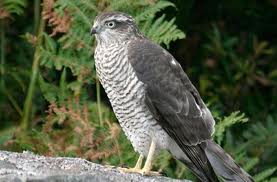
'Hilly' reports seeing a probable Sparrowhawk yesterday in the cherry tree by the Bothy. Sparrowhawks have nested in Brockley Cemetery for at least the last two years and sightings are reported from time to time.  See the blog post for 7 September 2008 by Keith for a record of his close encounter with a Sparrowhawk. Interestingly, when Keith started this blog back in 2007, he reported seeing quite large numbers of House Sparrows on the Cliffview side of the park, as many as 50 on one occasion. Nowadays, the most we see is 8. I wonder where they can all have gone? Unfortunately, "gardens have become one of their favourite killing fields" says Mark Cocker of the Sparrowhawk in his excellent book Birds Britannica. He notes also that they eat a wide range of birds "from the smaller members of the tit family to black grouse". Perhaps we could interest them in parakeets...


The other predator seen over Hilly Fields is the Kestrel. Sue recalls watching them nest and breed in the school building back in the 1980s (before it became Prendergast), but they are not quite so common around the park now. Only one sighting in 2012 as far as I know. The Kestrel is famous for hovering in one spot, almost standing still in mid-air while it searches the ground for prey. It does take small birds and chicks, but mice and voles are preferred. Keith (again) stumbled across one back in 2008 tearing apart what was probably a mouse at the edge of the meadow and got this photo of it standing over its prey.


So there we are - it's a bird-eat-bird world out there, sometimes. But at least their food chain gives birds of prey one big advantage over us. They always know what they're eating.

Friday, 2 March 2012

Leap Day Survey


Our February survey took place on a leap day (29th) though I'm sure to the birds it was just another morning and a mild one at that. A total of 22 species were seen or heard which is a good tally and includes a Dunnock heard singing in the trees bordering the south-east field, a fine pair of Mistle Thrushes in the wood and, for the first time this winter, a Redwing in the trees on Eastern Road. Yes - just one. For some reason, Redwings have given Hilly Fields a miss this year despite being seen in such nearby places as Brockley Cemetery, Brookmill Park, Ladywell Fields and Greenwich Park (450+ recorded there on 10 February).

What we do get on Hilly Fields are Common Gulls which are not always found in other local gull hotspots. Close examination of the flock on the north field around the cricket pitch revealed 10 Common and 28 Black-headed Gulls - a few of the latter actually sporting the "black head" (strictly speaking, dark brown) which develops in the spring and summer.

There were fewer Starlings than on Big Birdwatch day (30 compared to 80 then) and fewer Goldfinches (4 compared to the usual 16+). However, a healthy number of Chaffinches were around and a trio of Greenfinches were sitting in the Eastern Rd trees which they often frequent. Above the path that borders the east field, a Magpie was diligently building a new nest - a reminder that the main breeding season is almost upon us.


On the birds of prey front, Sue spotted a male Kestrel on 7 February perched on a ledge on the western side of Prendergast School, while Lawrence reports the following: "Today 23rd Feb 2012 we saw a pair of Sparrowhawks perch in a sycamore tree at the end of our garden between Wickham Rd and Breakspears, they sat apart for a while until a Jay attacked one and this revealed the other in the tree behind as they went for the Jay, didn't get it. Fantastic!" The Sparrowhawks may well be part of the family that nested in Brockley Cemetery last year. It's good to know that they're still around, though perhaps not so good for other birds!

Male kestrel


Sparrowhawk

Thursday, 6 August 2009

Kestrel unperturbed

Cllr Mike Keogh emailed me some photos he took a couple of days ago of the Kestrel in the meadow. Mike wrote:

"Have you seen the kestrel at the bottom of the school to bottom Montague Ave path, on lamppost just before trees. It is in and out of the meadow ... and hangs out on top of lighting column looking quite scruffy and unperturbed by passers-by."


This photo shows the Kestrel on a lamppost on the path near Prendergast School, which is in the background.
Thanks Mike.

Sunday, 19 July 2009

The Kestrel's back (& me too!)

After a few weeks absence on holiday in the Scottish Highlands and then essential maintenence around the house and garden I am, at last, back to the normal routine.

I must mention (because this is very rare) that the Highlands were dry and very hot: up to 30 degC. and only one rainy day. There were plenty of Osprey nearby, one even took a fish just 100m from our apartment, and no shortage of House Sparrows.

For the past few weeks Chris, from the RSPB, has been surveying Cliffview Road and this side of Hilly Fields weekly instead of monthly. When he was here on Thursday, Chris told me the weekly visits have been very successful, from the point of view of the London House Sparrow Project, but next week could be the last of the more frequent visits as breeding is almost over for this season.

I was in Hilly Fields this afternoon and met Keeper Justine who has quite an interest in the birdlife and brought me up-to-date on what was around. I filled the feeder in the Garden and then wandered over past the Playground when suddenly a Kestrel swooped down on something. Whatever it was must've got away because the two photos I managed show the Kestrel without a catch.


Thursday, 11 September 2008

Kestrel in the Meadow


Wandered over to the meadow to see the wildlife information board, and got a real treat: a Kestrel


I first spotted it sitting on a lamppost, and edged cautiosly closer to get a better photo.


Then it spotted me and flew off into a tree beside the school.

I walked slowly towards the tree, keeping to the footpath that curves up towards the playground and when I was nearly at the junction of paths it swooped down to catch something, probaby a mouse, in the undergrowth at the edge of the meadow.

I grabbed two more photos as the Kestrel ripped apart its catch


...and another as it flew away.