Some interesting news has turned up via the Comments column in my previous post. Gavin reports seeing a Short-eared Owl over Hilly Fields on 13 October last year. It was being mobbed by crows at the time and after a few minutes drifted away eastward without landing. Earlier that day, the same bird had been seen over the London Wetland Centre near Barnes where it was being mobbed by gulls. Just one of the perils of being a day-flying owl. We can be reasonably sure it was the same bird in both places as Short-eared Owls are quite scarce in London. Meanwhile, the Tawny Owl that we've mentioned in earlier posts has not been heard since mid-December, but as one correspondent pointed out, local residents tend to have their double-glazed windows firmly shut at this time of year. All owls are predators and prey on other birds as well as small mammals, which accounts for the preemptive mobbing. In this pic, a Short-eared Owl is about to make short work of a vole.
Photo: Mark Hancox
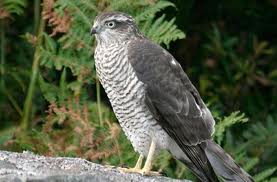
'Hilly' reports seeing a probable Sparrowhawk yesterday in the cherry tree by the Bothy. Sparrowhawks have nested in Brockley Cemetery for at least the last two years and sightings are reported from time to time. See the blog post for 7 September 2008 by Keith for a record of his close encounter with a Sparrowhawk. Interestingly, when Keith started this blog back in 2007, he reported seeing quite large numbers of House Sparrows on the Cliffview side of the park, as many as 50 on one occasion. Nowadays, the most we see is 8. I wonder where they can all have gone? Unfortunately, "gardens have become one of their favourite killing fields" says Mark Cocker of the Sparrowhawk in his excellent book Birds Britannica. He notes also that they eat a wide range of birds "from the smaller members of the tit family to black grouse". Perhaps we could interest them in parakeets...
The other predator seen over Hilly Fields is the Kestrel. Sue recalls watching them nest and breed in the school building back in the 1980s (before it became Prendergast), but they are not quite so common around the park now. Only one sighting in 2012 as far as I know. The Kestrel is famous for hovering in one spot, almost standing still in mid-air while it searches the ground for prey. It does take small birds and chicks, but mice and voles are preferred. Keith (again) stumbled across one back in 2008 tearing apart what was probably a mouse at the edge of the meadow and got this photo of it standing over its prey.
So there we are - it's a bird-eat-bird world out there, sometimes. But at least their food chain gives birds of prey one big advantage over us. They always know what they're eating.
After much rain beforehand, the sun came out just in time for our Big Birdwatch on Sunday 27 January. The event was well attended with some people taking a bird ID sheet and going round the park by themselves while others joined our guided walk. The birds were a little quieter than usual but between us we
clocked up a respectable tally of 21 species as indicated below. Particularly good views were had of the Great Spotted Woodpeckers and the Long-tailed Tits in the garden next to the Bothy, while the Common and Black-headed Gulls provided the highest numbers.
Meanwhile, back at the cafe, the Friends of Hilly Fields set up stall and provided activities for the little ones including the making of many suet balls and popcorn strings. If they eat everything that was hung from nearby trees, the birds will be too fat to fly for the next few days. Jason from Tlon Books came along too and sold copies of the appropriately themed children's book Brenda's Bottom and Her Birds by local author Clare Stanhope.
Thanks to Terry for helping to lead the guided walk, to Rachel and Andrew from the Friends and Judith from Glendale for running the stall and the childrens activities, to Phil for the work of art that was the blackboard (until we spotted more birds than he had room for), to Lee - the ever-helpful parkie from Glendale - and to Fred for letting us take over half the cafe terrace. Next event: the legendary Dawn Chorus Walk sometime this spring!
Incidentally, if you did the Birdwatch with young children this weekend, whether at Hilly Fields or at home, you can download a certificate for them from the RSPB website: http://www.rspb.org.uk/Images/certificate_tcm9-335163.pdf It opens in Adobe Reader which allows you to insert a name and make it look more official. You should also be able to get your printer (look under Properties) to add a touch of colour.
Finally, Colm dropped by to report that he'd seen 14 Fieldfares in the West Field the previous day - a day too early for our Birdwatch but we will add the sighting to Birdtrack, the national recording scheme that we use regularly. Fieldfares are thrushes and winter visitors from Scandinavia, usually found in flocks. They stand erect, grey heads, yellow bills, speckled breasts with a yellow-orange tint and brown backs and wings. Fieldfares are often seen at SE London locations including Ladywell Fields, but this is a first for us since we've been recording. They are a nomadic species flying to wherever they can find food, so now that they've found Hilly Fields, let's hope they return in future!
Fieldfare [photo John Richardson, Old Man of Minsmere blog]
Just a reminder that as part of the RSPB's nationwide bird survey this weekend, we will be holding our own Big Garden Birdwatch on Hilly Fields in conjunction with the Friends of Hilly Fields and Glendale.
Details are as per the poster above. There will fun activities for the little kiddies and a guided bird walk around the park. Or grab one of our bird ID sheets and do your own survey, but report back to the blackboard monitor (see below)! Please bring binoculars if you can. See you there: Sunday 27 January 10.30 - 12.30.
I mentioned the sighting of a female Blackcap on Hilly Fields in my "December Bird Survey" post. Since then, this little bird has made the national press and television (well, the Independent and BBC's Winterwatch at least) and it's all due to the British Trust for Ornithology. The BTO has initiated a January Blackcap garden survey, details of which can be found on their website: http://www.bto.org/. It has also produced evidence that Blackcaps which winter in the UK are not - as I confidently asserted - staying on after the spring migratory flocks return to Spain and North Africa in autumn, but are part of a separate population from Central Europe - particularly Germany. Whereas in the past, these birds have gone south from Germany in autumn, they now prefer to spend their winter vacation here (see the yellow arrow in the diagram below).
"What?!" I hear you say. "They prefer Britain to the Med! Talk about bird-brained..." But they've discovered that it's warm enough here and, even better, their return journey is much shorter, allowing them to get back quickly to Germany in the spring and nab the best nesting sites. Not so silly after all, eh? "We have a new winter bird" is how Michael McCarthy put it in the Independent. And the upshot for us is that we will have year-round Blackcaps in Hilly Fields, albeit not in great numbers. Their use of garden feeders is on the increase and if you have one, it is worth doing the BTO survey. In my experience, the feature that stands out in the Blackcap is its pale grey breast. Once you've seen that, check if they have a black head (male) or chestnut brown (female). Here's a close-up clip of a male:
Redwings are another species which winter in the UK, arriving in their thousands from Scandinavia. Members of the Thrush family, they have speckled breasts but the main distinguishing features are red patches on their sides and a white stripe over each eye. Yesterday we did a special mid-month survey of Hilly Fields prior to our Big Birdwatch event (Sunday 27 January at 10.30) and saw four of them which is the first sighting on HF since Keith recorded a small flock of seven two years ago.
In addition, we saw 30+ Starlings, 17 Goldfinches, 15 Wood Pigeons, 11 Common Gulls, lots of Great Tits, Blue Tits and Robins, Crows, Magpies, Blackbirds, Greenfinches, Chaffinches, Mistle Thrushes, House Sparrows and one each of Jay, Ring-necked Parakeet, Wren, Feral Pigeon and Black-headed Gull. A total of 20 species which augers well for the (stop me if I've mentioned this before) Big Birdwatch event on Sunday 27 January at 10.30. Incidentally, there seemed to be a growing awareness amongst some birds yesterday that the mating season is getting closer. Certainly, this Robin was singing very lustily in Hilly Fields Wood...
Firstly, please make a date in your diary or calendar for Sunday 27 January at 10.30. This is during the weekend of the annual RSPB Big Garden Birdwatch and we will once again be holding our own bird recording event - the 'garden' in this case being Hilly Fields. We will be based on top of the hill next to the cafe and will have a stall there with bird-orientated craft activities for children. The core of the event, however, will be bird surveying and you can either go round by yourselves or on a guided walk with one of us. We will provide illustrated checklists to assist. Please remember the two golden rules:
1. Only record the maximum number of species that you see at any one time (eg. if you see three Magpies in one location and three in another, that's three - not six!)
2. Don't count any birds passing overhead unless they touch down on Hilly Fields.
These are the RSPB's rules and are meant to avoid duplicate counting and distortion of data. Although some birds are territorial and don't budge much from their pitch, others zoom around all over the place.
We will collate all the findings on our hi-tech blackboard (see below) and send the final tallies off to the RSPB. If you want to do a survey that weekend in your back garden, then it's a good idea to register beforehand. Details are here: http://www.rspb.org.uk/
Secondly, the Hilly Fields Birdwatch stats department tell me that this is our 100th post! The majority of those posts were written by Keith who started the blog back in 2008, so full credit to him. We are not experts or twitchers, but bird lovers and bird watchers. The blog is not written for "birders", but for anyone who appreciates Hilly Fields and the role that it plays as a 'green space' in supporting nature. Thank you for taking the trouble to read our humble offerings and thanks for the feedback you send in. Hopefully, we will see you on Sunday 27 January at 10.30.
Our December bird survey took place on the 21st - a fine sunny day though the ground was still rain sodden in places. It was also the winter solstice, the shortest day of the year and, according to some, the day on which the world would end - although the Mayans were saying that was baloney. And of course they were right.
The better weather brought plenty of birds out, but the highlight was a clear view of a female Blackcap in the garden between bowling green and bothy. Blackcaps are warblers with a pretty song which we heard often last spring. They are still mainly spring migrants to the UK and spend the winter in Spain, Portugal or West Africa, but as our climate has warmed, a small population overwinters here (estimated as "3000 and increasing" by the RSPB). By coincidence, Sue had seen a male Blackcap in her garden a few days earlier, so it is gratifying to know that they are hanging on in lovely Lewisham. The male has a black head (hence the name 'Blackcap') and the female a brown head; both have a light grey breast. Our female didn't stay around long enough for me to get a photo, but here's one from the Web.
Female Blackcap
Just before the Blackcap appeared, we saw a Dunnock (possibly two) scrabbling around in the undergrowth. Dunnocks seem to be permanent residents of Hilly Fields, though we've never seen more than one or two at any one time and I doubt that there are many around the park. They are small, furtive birds that tend to creep around close to cover.
Dunnock
In all, we saw 17 different species during our walkabout. The 'big' numbers were 22 Blackheaded Gulls, 13 Starlings, 10 Woodpigeons and 9 Common Gulls. There were 6 House Sparrows in the Cliffview hedge which is slightly more than usual. We heard the high-pitched trilling of Goldfinches quite often, but never saw more than 4 together. Similarly, we heard and saw Robins, Great Tits and Blue Tits galore but never more than 3 at any one time. We also saw small numbers of Magpies, Crows, Blackbirds and Ring-necked Parakeets as well as a solitary Chaffinch and at one point heard a Greenfinch sneering at us from somewhere out of sight. Here's a shot of one of the Starlings high up in a poplar tree -they really do have attractive glossy speckled coats though you need a close-up view to appreciate it.
In other news, the Tawny Owl was heard again earlier this month by a Cliffview resident (thanks, Keith!). Great Tits which have been quiet since early summer can now be heard calling most days and other birds should be getting more vocal from January onwards. On which 'note', may I thank everyone who takes the time to visit and read (and occasionally comment on) Hilly Fields Birdwatch and wish you all the best for 2013.
What a difference a month can make. At the end of October, I was moaning about the "dense foliage" hiding the small birds from view. By 27th November when we did this month's bird survey, the trees were almost bare, having been helped by some strong autumn winds to shed their leaves. As a result, the small birds were much more visible, even through the drizzle that splattered our optical aids. Walking around the park, we saw and/or heard at least 8 Robins, a couple of Wrens moving around tree trunks looking for insects, Chaffinches, Blue Tits, plenty of Great Tits (with a couple calling but not yet in full voice) and a small number of Long-tailed Tits alongside them. Close up, the Long-tailed Tit is an excessively cute little bird as can be seen in this recent photograph by Dave Bushell from the Kent Wildlife Trust page on Facebook.
Winter flocks are building up as well. At one point on Eastern Road, we saw about 20 Goldfinch suddenly rise en masse from a single tree, startled by a Mistle Thrush flying nearby. And at least 20 Starlings were making a communal racket in a tree near the playground. On the lower field, the Black-headed Gulls had returned in force, having been absent for most of the month. Perhaps they'd heard that the weather was about to turn cold. We counted 40 in total with a pair of Common Gulls among them. And along the path that borders the Cliffview Rd back gardens, we found 7 House Sparrows lurking in the hedgerows - which almost does constitute a "flock" these days for what was once the commonest bird in London.
In addition, we saw Wood Pigeons, Feral Pigeons, Blackbirds, Crows, Magpies and our old friend or enemy, the Ring-necked Parakeet. A respectable tally of 18 different species in all.



.jpg)
.jpg)
.jpg)
.jpg)


