Tuesday, 5 November 2013

After the Storm

Our October survey took place a day after the so-called St Jude's storm. By then, the wind had dropped, the clouds were white and fluffy and there was even some blue sky and sunshine. When we entered the park halfway up Vicars Hill and saw a Dunnock sitting on a branch in the border scrub, I knew we were in for a good morning. This is the area where we heard it singing in the spring and is presumably its main territory. Seen from below, the Dunnock appears rather nondescript and similar to a House Sparrow. In silhouette, however, a needle-point bill can be seen quite unlike the chunky beak of the sparrow. Although the Dunnock is still sometimes called the 'hedge sparrow', the two birds are completely unrelated.

Dunnock in the Vicars Hill border
We were then distracted by a small gang of Blue Tits chasing each other at high speed around the trees and performing their usual acrobatics among the branches. This reoccurred elsewhere and was probably a release of pent-up energy after the end of the moulting period. On the eastern wall of Prendergast School, a rainwater gully attracted the Tits attention, perhaps as a drinking and dunking hole. A Pied Wagtail was also spotted nearby. Great Tits were out and about and were even heard calling although rather faintly. They don't normally get into their two-note stride until after Christmas. Among the Eastern Rd hawthorns we were pleased to see a small flock of Long-tailed Tits which are also fast and agile movers. The RSPB Handbook's description of them as 'restless' seems pretty accurate.

Blue Tit inspecting the drains
Another highlight was the sighting of both male and female Great Spotted Woodpeckers in the Eastern Rd area. How can you tell them apart? The male has a red cap at the back of its head, the female doesn't (see photo here). Both have bright crimson feathers under the tail and all juveniles have a red patch at the front of the head (see below) which disappears with the first moult. In total, we counted 19 species during our walkabout. As well as those already mentioned, we saw or heard at least 15 Wood and 6 Feral Pigeons, 7 House Sparrows in and around the Cliffview hedge, at least 5 Robins calling, 5 Crows, 2 Magpies and 2 Blackbirds. We also heard a Chaffinch, a Goldfinch, a Ring-necked Parakeet, at least one Wren and caught brief glimpses of a Mistle Thrush and a Starling. The Starlings have not yet returned in force from the outer suburbs but should be back soon along with the Black-headed and Common Gulls.

Woodpecker nestling in 2012
As for the storm, what damage has it caused on Hilly Fields? Several trees have been felled including, sadly, one of the two crack willows on the south slope. Lots of branches and whole limbs have been broken off including one in which our Great Spotted Woodpeckers nested in 2012. On the whole, though (and despite the dramatic looking photos below), St Jude's storm wasn't in the same league as the great overnight storm of 1987 which killed 18 people in England, felled an estimated 15 million trees and of course immortalised a certain weatherman.


One of the two crack willows on the south slope
The Woodpeckers' nesting tree in 2012

Tuesday, 8 October 2013

Sparrowhawks and Willow Warblers

September was a difficult month to organise a bird survey as the Hilly Fields bird champions slipped away on holiday at various times. It was in any case a quiet month for bird activity on the whole (as it was last year) for various reasons including the fact that some birds are still moulting, that the mighty effort of attracting mates and finding food for the young is over and that the need to defend territory is not quite so important. There is also a lull before the hordes of winter migrants arrive and before some non-migrant birds such as starlings and gulls return to the inner city. I did a walkabout one overcast morning and counted only 10 species, all of them common birds. However Sue had much better luck on the very last day of September and found 16 species including a Sparrowhawk and a Willow Warbler, so naturally we are recording that as our main survey of the month!

Sparrowhawk
The Sparrowhawk was soaring for some time over the south field adjoining Eastern Rd and Adelaide Ave and was probably hunting. It disappeared eventually in the direction of Brockley and Ladywell Cemeteries. The Willow Warbler is the first to be recorded on Hilly Fields, pushing our grand total since 2007 up to 42 different species. They are summer migrants and not uncommon in Lewisham, so I suspect it has visited the site before but not been detected. Its appearance is very similar to that of the Chiffchaff, although its song is quite different. Once it stops singing as most birds do around July, the observer has to try and make out 'paler legs, longer wings, slightly longer body,cleaner yellow underparts, clearer stripe above eye' (RSPB Handbook). Luckily, in this case, the bird was at eye level on a bush between the park and the Veda Rd back gardens and Sue could identify it fairly easily. By now, it will be well on its way back to West Africa. Let's hope it stops by again next year.

Willow Warbler (Credit: Andreas Trepte)
In addition to those already mentioned, Sue also recorded 8 Woodpigeons, 6 Blue Tits, 5 of Long-tailed Tit, Goldfinch and Robin, 4 of Blackbird, Great Tit and Ring-necked Parakeet, 3 of Crow, Feral Pigeon and Magpie and 1 each of House Sparrow, Chiffchaff and Goldcrest. Looking ahead, winter migrants are already starting to arrive in the UK and those that we're most likely to see on Hilly Fields are Redwings and Fieldfares, as well as - we hope - a few wintering Blackcaps from Central Europe. The Black-headed and Common Gulls should be moving inland and arriving late October. The Fieldfare which often goes around with Redwings (both being members of the Thrush family) is a handsome bird which I particularly hope to see again as we spotted only a small number last winter.

Fieldfare
Finally, a date for your diaries - 20 October. The Green Fair is coming! Lots of fantastic activities as listed below and some may even involve birds. Do come along and join in.


Footnote 1: I almost forgot to mention that a Tawny Owl was heard again during the month in the Eastern Rd area. No further information as yet but it was heard last year from September through to January, so a consistent pattern may be emerging. Please let us know via the comments facility if you hear it.

Footnote 2: Redwings and Fieldfares seen today (10 October) on Ladywell Fields.

Tuesday, 3 September 2013

Last Days of Summer

August 28th was a fine sunny day for our monthly survey but the birds weren't coming out to play. We heard more than we saw and our final tally was only boosted to 13 species by the screeching of an unseen Jay and the brief glimpse of a Green Woodpecker which was probably visiting from Brockley & Ladywell cemeteries. Great Tits and Blue Tits were fairly active in the trees and small flocks of Crows, Magpies and Woodpigeons followed us about the park. The good news is that Robins are singing again after their summer moult when they retreat into the undergrowth and sulk. We estimated that we'd seen or heard 7 in total on our rounds.


We saw only one Blackbird which is unusual and heard the occasional Goldfinch. Three House Sparrows, two Ring-necked Parakeets and a Feral Pigeon made up the total. The week before, Sue had seen even fewer birds but had at least the excitement of watching a Sparrowhawk being chased by a Crow! Before going for a coffee at the cafe, we took a look at a recently vacated Robin's nest just inside the bothy gates which Lee the park keeper had pointed out to us - a cup nest created in thick ivy against a wall. I wonder how many chicks were born here and how many survived?


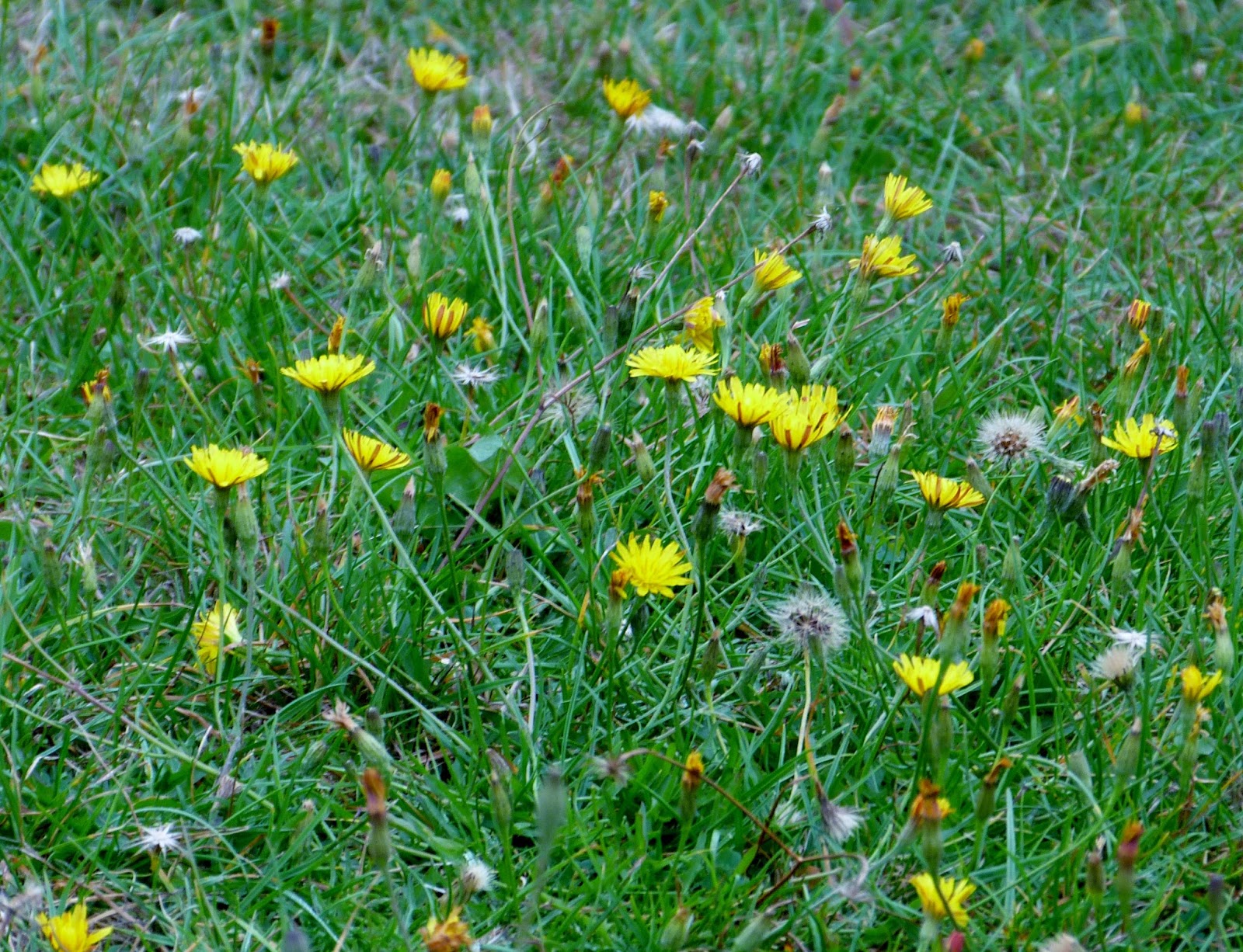
Elsewhere in Lewisham, a few Swallows have been seen which means they're probably starting to think about heading south. And in other news, blackberries are ripening again after having had just the right amount of sunshine and rainfall in the last few weeks. I haven't sampled the Hilly Fields crop, but tried some at the RSPB Rainham reserve in Essex and they were delicious. On the park grassland, buttercups have given way to swathes of little dandelion-like flowers. These have been identified for me by Nick Bertrand (ace Creekside Centre botanist) as Autumn Hawkbit. Taken together, all these signs can mean only one thing. The last days of summer are upon us.


Postscript 3rd September: heard a Chiffchaff singing again on Eastern Road this morning. I mentioned last month that a pair of Chiffchaffs had produced at least one youngster on Hilly Fields this summer. It's possible that they could overwinter here, but more likely that they'll be off back to the Med in 2-3 weeks time. And who can blame them?

Thursday, 1 August 2013

It Ain't Half Quiet

Time drifts on and we approach another transitional point in the bird year. The sounds of silence, or at least quietness, are upon us. There are still cheeps and chirps and calls to be heard out there, but song is on the way out. The 'dawn chorus' this morning consisted of a single Wren and some Herring Gulls mewing in the distance. The Blackbird which has been heard from 3.45 am during June and early July is resting its vocal cord and will not be singing again until next year. Likewise, Thrushes and Dunnocks. The Robin is also silent while it undergoes its moulting period, but it will sing again during the autumn. The breeding season is almost over.

Wren in my garden 
It wasn't quite so quiet when Sue, Terry and I did our monthly survey of Hilly Fields on a hot and windless 22nd July, but it was getting there. We heard a Blackcap sing for a short spell in the wood by Eastern Rd and a Chaffinch holding forth again from a tree near the school (see last month's post). But the only bird really belting it out was the Wren - several of them, in fact, repeatedly. Could this have been an avian lonely hearts club band? At a mere 10 cm in length (max), the Wren is almost Britain's smallest bird (beaten to that title by the Goldcrest and Firecrest) and is certainly our most common bird (click for link) with an estimated population of over 17 million. For such a small bird (weighing as little as a £1 coin), the Wren with its famous cocked tail is quite stocky and emits a loud and powerful five second song. Here's a You Tube clip...


The other striking feature of Hilly Fields bird life at the moment is the number of juvenile birds which is of course to be expected. The most significant was a young Chiffchaff which Terry spotted in the Eastern Rd hawthorns. We also saw one of the adults. This is good news for it means that the birds have bred in the park which is a "first" as far as we are aware in the six year duration of the bird champion scheme. In the past, Chiffchaffs have been heard only at the beginning or end of their migratory period. This year, two of them stayed around to mate and raise at least one little one. There were plenty of juvenile Tits as well, their colouring not yet as rich as their parents, and I spent some time tracking a young Robin which had not yet acquired its red breast, but it was hard to get decent photos of any of these small birds through all the foliage. The best image I could manage is the juvenile Wood Pigeon below which hasn't yet gained the white collar or the plumpness of its elders. It reminds me of that old chestnut of a question: why do you never see baby pigeons? The answer is because you don't look in their nests! Baby pigeons are fed such a rich diet by their parents and grow so fast as nestlings that by the time they fledge, they're as big as their mum and dad, or almost.

Juvenile 'Woodie'
We saw 17 species in total during our two hour walkabout. We also saw butterflies galore - in fact, thanks to the prolonged sunshine, urban green spaces are alive with them at present which makes it a great time to do the Big Butterfly Count (click for link). On Hilly Fields, the wildflower meadow is full of Meadow Browns while you might also see the Burnet 6 Spot, an attractive day flying moth, and you will certainly see a lot of very busy bees. In the wood and Eastern Rd area, the lovely Speckled Wood butterfly can be found.

Meadow Brown on Tansy in the wildflower meadow

Speckled Wood in the wood

STOP PRESS - Sue did another Hilly Fields walkabout on 30 July - 17 species seen including four Mistle Thrushes. Normally, we see two so it's safe to assume that they have successfully bred. She also heard a Nuthatch - an occasional visitor - and saw House Martins flying overhead with Swifts. A good result.

Thursday, 4 July 2013

Bedraggled Birds of June

It was an overcast but warm day on 26 June when Sue and I carried out our monthly survey. The tree foliage is now quite dense which makes it harder to spot the small birds but what we couldn't see, we heard - at least 8 Blackbirds and 8 Great Tits, at least 5 Blue Tits and 5 Wrens and at least 4 Robins. Sue also heard a quick burst of Chiffchaff song and, earlier in the month (18 June), actually watched it singing for some time in the Eastern Rd area, so it does seem as if the bird has stuck around this year. It was noticeable how bedraggled and frazzled some of the birds looked which is hardly surprising given the demands of the breeding season - the constant daily search for food, the need to defend the nest and distract predators (and bird watchers). An exception was the Great Tit below which left its tree trunk nest at a speed greater than my camera could cope with (I won't try the old 'artistic blurring' excuse)...


We saw three Long-tailed Tits, heard both a Blackcap and a Dunnock singing in the Eastern Rd/wood area, saw a single Swift overheard and also saw or heard Goldfinches, Magpies, Crows, Feral and Wood Pigeons, Ring-necked Parakeets, Starlings, House Sparrows and a single but very vocal Chaffinch - 19 species in all. We haven't paid that much attention to the Chaffinch on this blog partly because, although it's a 'regular', it's not very numerous on Hilly Fields. It's an attractive bird and, nationally, one of our commonest - the RSPB estimates nearly 6 million breeding pairs in the UK. One can usually be found singing around the front of the school building in the trees next to the playground and tennis courts (anyone who came on this year's Dawn Chorus walk will remember the fine view we had of a female Chaffinch singing outside the school) and, like the Chiffchaff, has a song that's very easy to remember - a series of fast descending notes ending in a short trill. This clip gives a fine view of the male Chaffinch (the female is drabber and greener) and a recording of its song:


Meanwhile, in other nature news, the May blossom on the hawthorns has gone along with the white cow parsley and creamy horse chestnut flowers. It's now the turn of the Elder trees and bushes to put on their white floral display along with briar roses in the borders and Pyracantha. All three could be found last week behind the school with the magnificent Pyracantha attracting bees by the busload. Go and see it while it's there!


Saturday, 15 June 2013

Bird List: 2007-2013

It is almost six years now since the Hilly Fields Bird Champion Project was launched by Lewisham Council. To provide some feedback, I submitted a report to the Lewisham Biodiversity Partnership in April which included a list of all bird species seen in the park since the project began. The report was discussed at the May meeting of the Partnership and was welcomed. A further initiative may derive from it which I will report on at a later date.

I will not rehash details of the report here as it can be read on the Lewisham Nature Conservation blog. However, I have reproduced the bird list below with the addition of a Lesser Black-backed Gull seen since the report was submitted. The birds are classified under Everyday which means you should see or hear them every time you visit the park; Regular which means they should be seen or heard often (in their season), perhaps at least once a week; Occasional which I think is self-explanatory; Rare which means rare to the area and to Inner London as a whole. Indeed, if a Cuckoo or Short-eared Owl were to stay on Hilly Fields for a while, it would almost certainly attract a few twitchers!

Although I suggest in the report that bird population levels in the park have been stable since 2007, Keith has pointed out that local House Sparrow numbers have declined during this period. As the original bird champion, he recorded as many as 50 during 2007-8, whilst 10 is the highest number seen nowadays. The sparrows are usually in and around the Cliffview hedge (see the site map) and the answer may lie in the fact that roof repair work carried out in some adjoining Cliffview Road houses not long ago may have disturbed their nests. It is likely therefore that some of the sparrows have simply relocated elsewhere in the neighbourhood which is not short of this once ubiquitous bird. I've noticed a thriving population recently, for example, along the Ravensbourne at Cornmill Gardens.

A word about the Chiffchaff which is number 26 on the list. This is a warbler which usually arrives on our shores in late March and April. It is not by any means rare or even 'occasional' at other local sites. It can be heard regularly at Ladywell Fields and Brookmill Park, for example. At Hilly Fields, however, I've heard it only three times this spring and have suggested that it simply rests here before moving on elsewhere. On 2 June, however, I heard it singing from the top of an Eastern Rd tree for about 15-20 minutes as if it were seeking out a partner.


Could it be breeding in the park? The photo above was taken at full zoom against the sky and is not very clear, but this earlier post includes a clip of the Chiffchaff's short simple song which begins nine seconds into the video. It is perhaps the easiest of the warblers to identify. Please let us know if you hear it.

So here is the bird list - 41 different species identified since 2007. Onwards to the half century!

Hilly Fields Bird List: 2007-2013

Everyday

1. Blackbird  (resident)                

2.   Black-headed Gull  (resident - winter months)
3.   Blue Tit  (resident)
4.   Carrion Crow  (numbers vary but thought to be 4 residents)
5.   Common Gull  (resident - winter months)
6.   Goldfinch  (daily visitors in a flock of up to 20 birds on occasion)
7.   Great Tit (resident)
8.   House Sparrow  (resident)
9.   Magpie (numbers vary but thought to be 2/3 residents)
10.  Ring-necked Parakeet  (daily visitors in small numbers) 
11. Robin (resident)
12. Wood Pigeon  (resident)
13. Wren  (resident)

Regular

14. Blackcap  (summer and winter migrants)

15. Chaffinch  (probably resident)
16. Common Swift  (seen overhead in summer months
17. Dunnock  (probably resident
18. Feral Pigeon (small no, easily outnumbered by wood pigeons)
19. Great Spotted Woodpecker  (resident pair)
20. Greenfinch  (probably resident)
21. Jay  (regular pair - possibly resident)
22. Long-tailed Tit  (unsure whether residents)
23. Mistle Thrush  (regular pair - probably residents)
24. Pied Wagtail  (seen on bowling green and on stone pathways)
25. Starling  (as many as 80 seen in winter months; disappeared during 2012 summer months)

Occasional

26. Chiffchaff  (heard since 2011 at spring and autumn migration times only)

27. Coal Tit (very occasional)
28. Collared Dove  (very occasional)
29. Fieldfare  (occasional in winter
30. Goldcrest  (possibly visitors from nearby Brockley/Ladywell cemeteries)
31. Green Woodpecker  (also possibly visitors from above)
32. House Martin  (not recorded since 2008)
33. Kestrel  (very occasional)
34. Lesser Black-backed Gull (very occasional)
35. Nuthatch  (very occasional)
36. Redwing   (seen more in winter/early spring 2013
37. Sparrowhawk  (possibly the birds that are known to have bred in Brockley Cemetery)
38. Stock Dove  (very occasional)
39. Tawny Owl  (heard by Cliffview Road residents in  autumn/winter 2012/13, not seen)
40. Willow Warbler. Seen and heard for the first time September 2013

Rare

41. Bullfinch (male, seen by Peter on 19/12/10 on SE edge of the park)

42. Cuckoo  (heard once in May 2011)
43. Mallard  (two seen by Rachel 10/3/08 approx 7am 'waddling up the park end of Eastern Rd')
44. Short-eared Owl  (seen overhead 13/10/12 being mobbed by crows. Probably same bird recorded over London Wetland Centre earlier that day

Updated Jan 2014


Tuesday, 28 May 2013

A Tit Without A Tail

I had seen it twice in the third week of May. Up in the hawthorns on Eastern Road - a very small bird looking from below like a ball of pale fluff, always in the company of a Long-tailed Tit and moving rapidly between branches and trees. It kept making a high "tseeping" sound and I had thought: Goldcrest? Very recent fledgling of some sort? At times, it hovered between branches fluttering its wings as if to keep airborne, but usually it had no problem flying fast or in a reasonably straight line.Then, on 22 May while doing the monthly bird survey with Sue, we both saw it and  reached the conclusion that what we were looking at - from the visible head markings and general behaviour - could only be a Long-tailed Tit without a tail.

Back home, a quick surf through Google proved that tail-less tits, though not common, are seen from time to time. The lack of a tail is usually the result of an accident or a predator attack. It doesn't seem to affect their ability to forage and frolic (like a "manic pom-pom" is how one tail-less tit is described) and the tail normally grows back after about four weeks. I haven't been able to photograph the Eastern Rd pom-pom, but here's a pic from the web::

From Asigaru's Nature Diary
Long-tailed Tits are nesting in the densest bramble scrub you could find on Eastern Rd where their chicks should be safe until fledged. This is good news as they are one of five key species among Hilly Fields regulars which re-assure me that the park is still providing a good diverse habitat. The other four are: Blackcap, Great Spotted Woodpecker, Jay and Mistle Thrush. Yes, I know you could add the "at risk" House Sparrow, the Dunnock, the Greenfinch (not seen often and in decline nationally), but I'll stick with my "big five" for now.

Sue and I saw four of those five key species during our May survey, the only absentee being the Mistle Thrush. There were plenty of birds singing, but the foliage is back on the trees and seeing the smaller birds is getting harder again. Our list for that day (of birds seen or heard) is as follows: Blackbird (6), Blackcap (1), Blue Tit (4), Crow (3), Chaffinch (1), Chiffchaff (1), Collared Dove (2 - an unusual sighting on Hilly Fields), Dunnock (1 - singing in the Vicars Hill border), Feral Pigeon, Goldfinch (3+), Great Spotted Woodpecker (1), Great Tit (4), House Sparrow (2), Jay (1), Long-tailed Tit (3), Magpie (2), Ring-necked Parakeet (1), Robin (5), Starling (6), Swift (2 - soaring overhead), Woodpigeon (3) and Wren (5+).  22 species - one of our best results. The Chiffchaff is only the second we've heard on Hilly Fields since their arrival in the UK in late March/April.  And it occurred to me that the Jay would be able to hide itself better in thick woodland or scrub without that bright blue wing patch which gave it away this time. Here's a photo of one I took a few days earlier on the open edge of Hilly Fields wood:


Around the park in general, spring has sprung with a vengeance after the extended midwinter cold. All of the trees are in leaf, the horse chestnuts have their creamy-white flowers, the May blossom has appeared on the hawthorns, there are daisies and bulbous buttercups and even the occasional bee or butterfly. And one particular plant - as you can't fail to have noticed if you've been there recently - is romping away:


Yes, you can hardly see the trees for the cow parsley.